
Search results will appear as highlighted text.
Quick Navigation
INTRODUCTIONEXPERIENTIAL RELIGIONTHE WAGES OF SINTHE DEFINITION OF SINTEMPTATION IS NOT SINHOW DOES THE NEW CREATION WALK?YOU MUST WALK IN NEWNESS OF LIFETHE BEHAVIOUR OF THE OLD MANTHE INHERITED ADAMIC SIN NATURETHE MANIFESTED PURPOSE OF CHRISTSUMMARY: THE SIN QUESTION (PART 1)SUBMISSION TO COGMA FOR APPRAISAL
INSTRUCTIONS FOR THE STUDENT
My Study Plan:
The book of Revelation reveals Jesus Christ and shows how God’s final Gospel Day is understood through spiritual prophecy. Preparing a Study Plan before starting this Study Guide will assist you in completing it within a designated timeframe. It also helps in developing the discipline required for studying God’s Word effectively.
Proverbs 16:3:
Commit thy works unto the LORD, and thy thoughts shall be established.
My Study Guide Journal
Keep a record as you progress through your Study Guide, including the “Personal Responses”, for each section for future reference and goal setting.
Content
- INTRODUCTION
- EXPERIENTIAL RELIGION
- THE WAGES OF SIN
- THE DEFINITION OF SIN
- TEMPTATION IS NOT SIN
- HOW DOES THE NEW CREATION WALK
- YOU MUST WALK IN NEWNESS OF LIFE
- THE BEHAVIOUR OF THE OLD MAN
- THE INHERITED ADAMIC SIN NATURE
- THE MANIFESTED PURPOSE OF CHRIST
- SUMMARY
Important Points:
- COGMA does not claim to be infallible or the authority.
- Infallibility and authority belong only to God and His Word.
COGMA therefore strongly advises that you prayerfully study the content of each Study Guide with the heart of a Berean: “Acts 17:10-12”.
Contact and Links
Website: https://homeschool.org.au/
Email: admin@cogma.org.au
Radio COGMA: https://radiocogma.com/
YouTube: https://www.youtube.com/@COGMAChannel
Facebook: https://www.facebook.com/profile.php?id=61585399471540
COGMA therefore strongly advises that you prayerfully study the content of each workbook with the heart of a Berean: "Acts 17:10-12".
INTRODUCTION
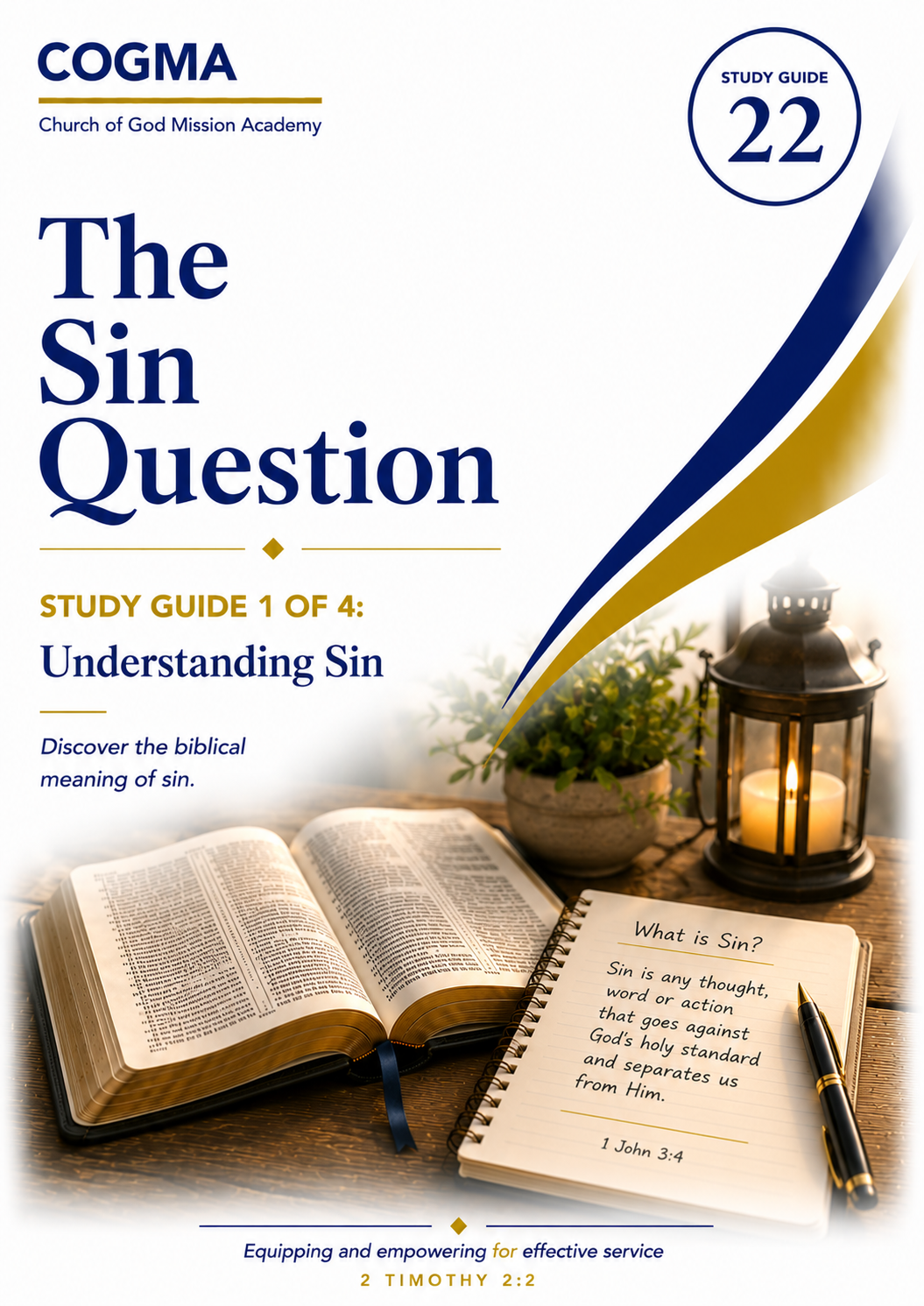
This Study Guide, "The Sin Question," examines what the Bible teaches about sin and the act of sinning. It forms a foundation for the next module, The Cause of the Gospel, which explores the reasons behind human sin and the purpose of the Gospel.
Many believe there are two types of sin:
- Inherited Sin Nature — thought to be inherited from Adam, also called "original sin."
- Personal Sin — acts committed individually.
Most Roman Catholic and Protestant groups teach that, because of an inherited sin nature from Adam, it is inevitable to sin daily in thoughts, words, and actions. This belief is extended even to born-again believers, who, according to this teaching, need daily cleansing to stay connected with Christ.
Certain verses are often taken out of context to support this idea.
1 John 1:8 says:
“If we say that we have no sin, we deceive ourselves, and the truth is not in us.”
Romans 3:10 says:
“As it is written, There is none righteous, no, not one.”
Despite this widespread teaching, it contradicts Paul's message in his letter to the Romans.
Romans 6:1–2 says:
“What shall we say then? Shall we continue in sin, that grace may abound? God forbid. How shall we, that are dead to sin, live any longer therein?”
Some groups, such as Baptist denominations, teach that salvation, once received, is permanent. They believe God sees people as either "good children" who follow His will or "bad children" who do not, and argue that once a person becomes a child of God, they remain so regardless of their actions.
However, the Bible clearly states that believers can lose their salvation by straying away.
Hebrews 10:26 says:
“For if we sin wilfully after that we have received the knowledge of the truth, there remaineth no more sacrifice for sins.”
1 Timothy 4:1 says:
“Now the Spirit speaketh expressly, that in the latter times some shall depart from the faith, giving heed to seducing spirits, and doctrines of devils.”
Even Paul himself acknowledged the possibility of falling away.
1 Corinthians 9:27 says:
“But I keep under my body, and bring it into subjection: lest that by any means, when I have preached to others, I myself should be a castaway.”
Using the study methods from the module How to Study, particularly the Golden Rule, this Study Guide sets out to reveal the truth about sin and sinning.
Personal Response
Key Truth
What is the main truth this Introduction has shown about how the question of continuing sin must be settled?
Personal Reflection
Have you ever accepted a teaching about sin because it was widely held, without testing it against Scripture itself?
Action Step
What is one specific verse or teaching about sin you will study for yourself this week, using the Golden Rule rather than relying on what others have told you?
EXPERIENTIAL RELIGION
A common question that arises when discussing whether a born-again believer continues to sin is: "Do you still sin?" This question is irrelevant, because what matters is not whether a professing believer sins, but what the Bible says about believers continuing in sin. What matters is God's view in His Word.
i.
God's Standard in the Bible
The Bible, as God's Word, sets the standard for life and determines a person's eternal destiny. Therefore, the question of sinning should always be based on "thus saith the Lord" and not on personal experience.
Jesus, the Word of God, declared that He is "the way, the truth, and the life." In Matthew 10, while sending out His twelve disciples, He advised them whom to trust and fear.
Matthew 10:28 says:
“And fear not them which kill the body, but are not able to kill the soul: but rather fear him which is able to destroy both soul and body in hell.”
ii.
Misinterpretation of Scripture
People who continue to sin often try to justify their actions by finding Scriptures that seem to support their beliefs. They may use Romans 7 to argue that even Paul, as a believer, continued to sin, but they overlook Paul's teaching in Romans 6 and Romans 8, explored later in this Study Guide.
A common misquote comes from 1 John 1:8.
1 John 1:8 says:
“If we say that we have no sin, we deceive ourselves, and the truth is not in us.”
This verse is often paraphrased as, "If any man says he lives without sin, he is a liar, and the truth is not in him." However, this interpretation ignores other, contradictory verses by the same writer, such as:
1 John 3:6 says:
“Whosoever abideth in him (Christ) sinneth not: whosoever sinneth hath not seen him, neither known him.”
iii.
Experiential Religion versus the Word of God
Many denominations base their beliefs on experiential religion, which relies on feelings, experiences, and emotions rather than the Word of God. For example, some may claim, "I speak in tongues, so I have the Holy Spirit," or "I feel God's presence, so I must be right."
iv.
Seeking Truth Without Bias
Proper study of God's Word seeks truth without bias. True believers examine all Scriptures carefully to ensure their understanding aligns with God's revealed truth. A clear example is Job, who, even when he did not feel God's presence, held firmly to His Word.
Job 23:8–12 says:
“Behold, I go forward, but he is not there; and backward, but I cannot perceive him: On the left hand, where he doth work, but I cannot behold him: he hideth himself on the right hand, that I cannot see him: But he knoweth the way that I take: when he hath tried me, I shall come forth as gold. My foot hath held his steps, his way have I kept, and not declined. Neither have I gone back from the commandment of his lips; I have esteemed the words of his mouth more than my necessary food.”
Personal Response
Key Truth
What is the main truth these sections reveal about the difference between experiential religion and the Word of God as the standard for truth?
Personal Reflection
Do you ever find yourself testing a belief by how it feels rather than by what Scripture actually says?
Action Step
What is one belief about sin you hold that you will test this week against Scripture alone, following Job's example of holding to God's Word even without feeling His presence?
v.
Gathering Evidence Impartially
In studying God's Word, believers must gather evidence impartially, guided by Scripture rather than by preconceived beliefs. The Bible calls this a "just balance."
Proverbs 11:1 says:
“A false balance is abomination to the LORD: but a just weight is his delight.”
vi.
Jesus, the Perfect Stone and Just Weight
The term "just weight" points to Jesus, the "perfect stone," as Isaiah describes.
Isaiah 28:16 says:
“Therefore thus saith the Lord GOD, Behold, I lay in Zion for a foundation a stone, a tried stone, a precious corner stone, a sure foundation: he that believeth shall not make haste.”
vii.
Seeking God's Truth Over Experience
In seeking to understand the truth about sin and righteousness, believers must rely on the Word of God, not on personal experience or feelings. Scripture presents Jesus as the cornerstone by which all teachings and beliefs are to be measured. Those who cling to experiential religion often stumble over this truth. Just as Job asked to be judged with an "even balance," every believer must ensure their beliefs align with God's Word rather than subjective experience.
Job 31:6 says:
“Let me be weighed in an even balance, that God may know mine integrity.”
Believers are called to continue pursuing the truth of Scripture, relying on the perfect foundation God has laid in Christ.
Personal Response
Key Truth
What is the main truth Lesson 1 has shown about how truth concerning sin must be established?
Personal Reflection
Where might you be more shaped by experiential religion than you realised?
Action Step
What is one specific step you will take this week to weigh a belief you hold in the "even balance" of Scripture, following Job's example?
THE WAGES OF SIN
Paul's words in Romans 6:23 emphasise the seriousness of sin.
Romans 6:23 says:
“For the wages of sin is death; but the gift of God is eternal life through Jesus Christ our Lord.”
This is a matter of life and death, and it is crucial for every individual to understand. There is no margin for error in determining whether continuous sinning is compatible with being a child of God. The answer determines eternal life or death.
Paul contrasts two paths with distinct outcomes.
i.
The Gift of God
God offers salvation as a gift, giving eternal life through Christ. The presence of Christ within a believer serves as the testimony of this salvation.
Romans 8:9 says:
“But ye are not in the flesh, but in the Spirit, if so be that the Spirit of God dwell in you. Now if any man have not the Spirit of Christ, he is none of his.”
ii.
Sin Is Death
Sin leads to death, both spiritual and eternal. This consequence results from living in unrighteousness and choosing the wrong path.
In Adam's story, this "death" refers to spiritual death, not physical. When Adam disobeyed God, he experienced spiritual death, symbolised by his expulsion from the Garden of Eden, which represents separation from God.
Genesis 2:16–17 says:
“And the LORD God commanded the man, saying, Of every tree of the garden thou mayest freely eat: But of the tree of the knowledge of good and evil, thou shalt not eat of it: for in the day that thou eatest thereof thou shalt surely die.”
Adam's punishment was immediate spiritual death, evidenced by his removal from Eden.
Genesis 3:24 says:
“So he drove out the man; and he placed at the east of the garden of Eden Cherubims, and a flaming sword which turned every way, to keep the way of the tree of life.”
The question of whether a born-again believer can continue in sin must be answered from God's Word, not from personal belief or experience.
Personal Response
Key Truth
What is the main truth these sections show about the connection between sin and spiritual death?
Personal Reflection
How does understanding Adam's spiritual death, rather than physical death, change how you think about the consequences of sin?
Action Step
What is one way you will remind yourself this week that the question of sin is a matter of life and death, not a minor issue?
iii.
Jesus Came to Save Us from Sin
Matthew 1:21 explains the purpose of salvation.
Matthew 1:21 says:
“And she shall bring forth a son, and thou shalt call his name JESUS: for he shall save his people from their sins.”
The Greek word "from" (apo) in this verse implies separation or departure. Jesus came to save people from their sins, not while they remain in them.
Sinning creates a clear division between those who are born again and those who are unsaved, living under the influence of Satan. The path of unrighteousness leads to death, while the path of righteousness leads to life.
Romans 6:12–13 says:
“Let not sin therefore reign in your mortal body, that ye should obey it in the lusts thereof. Neither yield ye your members as instruments of unrighteousness unto sin: but yield yourselves unto God, as those that are alive from the dead, and your members as instruments of righteousness unto God.”
Believers are called to refrain from sinning, though the ability to sin still exists.
iv.
Key Truths
- The wages of sin is death; the gift of God is eternal life through Christ.
- Adam's death at the fall was spiritual, not physical, shown by his expulsion from Eden.
- Jesus came to save people from their sins, not to leave them in sin.
- Believers are called to refrain from sinning, though the capacity to sin remains.
Personal Response
Key Truth
What is the main truth Lesson 2 has shown about the wages of sin and the gift of God?
Personal Reflection
Do you tend to think of sin mainly as a moral failure, or do you also see it as leading toward spiritual death and separation from God?
Action Step
What is one instrument of your life — your mind, your speech, your body — you will yield to God this week as an instrument of righteousness rather than unrighteousness?
THE DEFINITION OF SIN
There is an account of a young boy who, after returning from church, was asked what the preacher had spoken about. He said the preacher had talked a great deal about sin. When asked what the preacher had actually said about it, the boy replied that he could not remember the words, but he could tell the preacher did not like it.
Like the young boy, most people view sin as something negative but lack a clear understanding of its true nature. Various religious teachings have spread misconceptions about sin that are not rooted in Scripture. For example:
- Some teach that the devil was an angel who sinned and was cast out.
- Others believe that babies are born with sin and need baptism to avoid damnation.
- A doctrine suggests that all Christians sin daily in thought, word, and deed.
i.
Scriptural Definitions of Sin
In the New Testament, two verses primarily define sin.
1 John 3:4 says:
“Whosoever committeth sin transgresseth also the law: for sin is the transgression of the law.”
This refers not to the law of Moses, but to the law of the Kingdom of God, as defined by Jesus.
Matthew 22:37–40 says:
“Jesus said unto him, Thou shalt love the Lord thy God with all thy heart, and with all thy soul, and with all thy mind. This is the first and great commandment. And the second is like unto it, Thou shalt love thy neighbour as thyself. On these two commandments hang all the law and the prophets.”
The second defining verse is from James.
James 4:17 says:
“Therefore to him that knoweth to do good, and doeth it not, to him it is sin.”
ii.
Sin as Lawlessness
In 1 John 3:4, the term "transgression" is better translated as lawlessness.
1 John 3:4 (YLT) says:
“Every one who is doing the sin, the lawlessness also he doth do, and the sin is the lawlessness.”
1 John 3:4 (LITV) says:
“Everyone practicing sin also practices lawlessness, and sin is lawlessness.”
Sin and sinning are acts of lawlessness — living outside the boundaries of God's Word. Lawlessness is unrighteousness, living in opposition to Jesus Christ and His Word.
iii.
Righteousness in Christ
A true believer lives within the bounds of God's Word, seeing Christ as their righteousness.
In John 14:6, Jesus declared that He is "the way."
1 Corinthians 1:30 says:
“But of him are ye in Christ Jesus, who of God is made unto us wisdom, and righteousness, and sanctification, and redemption.”
Living outside the righteousness of Christ is sin, which leads to spiritual death.
Isaiah 59:2 says:
“But your iniquities have separated between you and your God, and your sins have hid his face from you, that he will not hear.”
Sin involves a wilful transgression of God's law, requiring knowledge of His commands and their consequences.
Personal Response
Key Truth
What is the main truth these sections show about sin being defined as lawlessness rather than as an inherited condition?
Personal Reflection
Has your own understanding of sin been shaped more by tradition or by these specific scriptural definitions?
Action Step
What is one commandment of Christ — such as loving God or loving your neighbour — you will deliberately obey this week as a direct response to this definition of sin?
iv.
Sin and the Law
1 Corinthians 15:56 says:
“The sting of death is sin; and the strength of sin is the law.”
Where there is no knowledge of the law, there can be no sin. 1 John 3:4 can therefore be understood as sin being the wilful transgression of the law.
Types of Sin in the Old Testament
The Old Testament outlines four main types of transgressions.
i.
Sins of Ignorance
In Leviticus 4:27–28, sins of ignorance are described as violations of God's commandments done unknowingly. These are not deliberate acts of rebellion against God's Word.
Leviticus 4:27–28 says:
“And if any one of the common people sin through ignorance, while he doeth somewhat against any of the commandments of the LORD concerning things which ought not to be done, and be guilty; Or if his sin, which he hath sinned, come to his knowledge: then he shall bring his offering, a kid of the goats, a female without blemish, for his sin which he hath sinned.”
Such sins, once realised, require confession and an offering for forgiveness. For a New Testament believer who studies the Word of God diligently, this scenario may be rare.
There is a common misconception that children commit sins of ignorance before reaching the age of accountability. However, without knowledge of God's law and the consequences of breaking it, sin is not possible. Children are born spiritually alive but are influenced by the flesh until they are born again. Awareness of God's law comes with the awakening of conscience at the age of accountability, as determined by God. This topic is explored further in the module The Cause of the Gospel.
ii.
Involuntary Transgression
Involuntary transgressions occur when someone unintentionally causes harm. A biblical example might be when two people are chopping wood and the axe head accidentally flies off and kills someone. In such cases, there is no intent, and this removes the element of guilt. The motive or intent behind an action is what gives character to the act. If the act is without harmful intent, it does not carry the same weight of guilt as a deliberate sin.
iii.
Sins of Commission
Sins of commission involve doing something that God has forbidden — direct violations of God's moral law. Examples include:
- You shall have no other gods before Me.
- You shall not murder.
- You shall not commit adultery.
- You shall not steal.
Jesus encapsulates these commandments with a call to obedience.
John 14:15 says:
“If ye love me, keep my commandments.”
A well-known example of a sin of commission is Adam and Eve's disobedience in eating from the tree of the knowledge of good and evil. Despite knowing God's command, they chose to disobey, committing a wilful act against His instruction.
iv.
Sins of Omission
Sins of omission are the failure to do what God has instructed — not acts of direct disobedience, but instances where a person neglects a duty or fails to take action as required by God. Examples include:
- You shall love the Lord your God with all your heart, soul, and mind (Matthew 22:37).
- Go into all the world and preach the Gospel (Mark 16:15).
- Speak the truth in love (Ephesians 4:15).
Sins of omission are just as significant as sins of commission, because both lead to disobedience and spiritual separation from God.
Two Ways to Commit Sin
At first it might seem that 1 John 3:4 and James 4:17 speak of the same type of sin, with James's verse acting as a clarification. However, this is not the case. John's letter was written after James, and each verse addresses a different form of sin.
- 1 John 3:4 defines the sin of commission — doing something that God has forbidden.
- James 4:17 defines the sin of omission — failing to do what God commands.
Both verses together show that these are the only two ways to commit sin according to Scripture.
i.
Key Truths
- Sin is defined in Scripture as lawlessness and as knowing to do good and not doing it.
- Sin requires knowledge of God's law; where there is no knowledge, there is no sin.
- Old Testament sins of ignorance and involuntary transgression involved no wilful intent.
- Sins of commission and sins of omission are the only two ways to commit sin according to Scripture.
Personal Response
Key Truth
What is the main truth Lesson 3 has shown about how the Bible defines sin?
Personal Reflection
Which do you more often overlook in your own life — sins of commission or sins of omission?
Action Step
What is one sin of omission — something God has instructed that you have neglected — you will begin obeying this week?
TEMPTATION IS NOT SIN
It is a common misconception that experiencing a wrong thought or temptation is itself sin, but this is not the case. Temptation in itself is not sin.
Even Jesus experienced temptation yet remained sinless.
Hebrews 4:15 says:
“For we have not an high priest which cannot be touched with the feeling of our infirmities; but was in all points tempted like as we are, yet without sin.”
Every believer will face wrong thoughts, but it is how these thoughts are handled that determines whether they lead to sin. Dealing with temptation properly is crucial for every Christian.
The devil can influence a believer's thoughts, but he cannot force anyone to sin. This makes it essential to maintain control over one's thoughts and align them with Christ.
2 Corinthians 10:5 says:
“Casting down imaginations, and every high thing that exalteth itself against the knowledge of God, and bringing into captivity every thought to the obedience of Christ.”
Temptation stems from selfish desires, trying to draw a person away from Christ and toward the love of the world. Understanding the root of temptation helps believers recognise and overcome it.
i.
Temptation Stems from Selfishness
Temptation often pulls believers away from reliance, trust, and joy in Christ. It aims to entice them to love the world and its offerings. John warns against this in his letter.
1 John 2:15 says:
“Love not the world, neither the things that are in the world. If any man love the world, the love of the Father is not in him.”
The word "world" in John 3:16 refers to God's love for humanity, while in 1 John 2:15 it refers to sinful systems and rebellion against God. Paul highlights this worldly influence as the course of the world.
Ephesians 2:2 says:
“Wherein in time past ye walked according to the course of this world, according to the prince of the power of the air, the spirit that now worketh in the children of disobedience:”
When believers choose the world over God, it shows dissatisfaction with God's sufficiency. John emphasises that love for the world is incompatible with the love of God.
James 4:4 says:
“Ye adulterers and adulteresses, know ye not that the friendship of the world is enmity with God? whosoever therefore will be a friend of the world is the enemy of God.”
The word "enmity" here comes from the Greek word echthra, meaning hostility or opposition.
The Three Forms of Temptation
John identifies three forms of temptation that aim to draw believers away from God.
1 John 2:16 says:
“For all that is in the world, the lust of the flesh, and the lust of the eyes, and the pride of life, is not of the Father, but is of the world.”
These temptations are the main strategies the devil uses to lure people into sin.
Personal Response
Key Truth
What is the main truth these sections show about where temptation comes from and why love for the world is incompatible with love for God?
Personal Reflection
Which of the three areas — the flesh, the eyes, or pride — do you sense the world drawing you toward most often?
Action Step
What is one specific way you will guard against the friendship of the world this week?
i.
The Lust of the Flesh
The lust of the flesh refers to inward cravings for material or earthly pleasures. These desires distract from God, leading believers to seek satisfaction in things other than Him.
ii.
The Lust of the Eyes
The lust of the eyes refers to the external temptation of wanting things that do not belong to a person. This often leads to covetousness and dissatisfaction with what God has provided.
Matthew 6:22–23 says:
“The light of the body is the eye: if therefore thine eye be single, thy whole body shall be full of light. But if thine eye be evil, thy whole body shall be full of darkness.”
David's sin with Bathsheba is a vivid example of how the lust of the eyes can lead to sin. In contrast, Job provides a model for resisting this temptation.
Job 31:1 (Amplified Bible) says:
“I have made a covenant (agreement) with my eyes; How then could I gaze [lustfully] at a virgin?”
iii.
The Pride of Life
The pride of life refers to arrogance, boasting, and relying on self-sufficiency rather than on God. It is an outward display of sinful behaviour that places confidence in personal achievements or possessions.
1 John 3:17 says:
“But whoso hath this world's good, and seeth his brother have need, and shutteth up his bowels of compassion from him, how dwelleth the love of God in him?”
The devil used these same three temptations on Eve in the Garden of Eden.
Genesis 3:6 says:
“And when the woman saw that the tree was good for food (lust of the flesh), and that it was pleasant to the eyes (lust of the eyes), and a tree to be desired to make one wise (pride of life), she took of the fruit thereof, and did eat, and gave also unto her husband with her; and he did eat.”
Preparation for Overcoming Temptation
To resist temptation, believers must be prepared. The enemy uses the lust of the flesh, the eyes, and the pride of life to lead Christians astray, but God provides spiritual tools to overcome these challenges.
1 Peter 5:8–9 says:
“Be sober, be vigilant; because your adversary the devil, as a roaring lion, walketh about, seeking whom he may devour: Whom resist stedfast in the faith, knowing that the same afflictions are accomplished in your brethren that are in the world.”
As Benjamin Franklin observed, "By failing to prepare, you are preparing to fail." King Rehoboam failed because he did not prepare his heart to seek the Lord, leading him into sin.
2 Chronicles 12:14 says:
“And he did evil, because he prepared not his heart to seek the LORD.”
Paul instructs believers to put on the whole armour of God to resist the enemy's schemes.
Ephesians 6:10–11 says:
“Finally, my brethren, be strong in the Lord, and in the power of his might. Put on the whole armour of God, that ye may be able to stand against the wiles of the devil.”
i.
Taking Control of Your Thoughts
All temptation begins with thoughts, so managing one's thought life is essential to resisting sin. Dwelling on wrong things makes a person more likely to fall into temptation. Controlling the mind and placing trust in Christ is vital to overcoming these challenges.
Isaiah 26:3 says:
“Thou wilt keep him in perfect peace, whose mind is stayed on thee: because he trusteth in thee.”
Paul also offers valuable counsel on focusing one's thoughts on things that are righteous and good.
Philippians 4:4–8 says:
“Rejoice in the Lord alway: and again I say, Rejoice. Let your moderation be known unto all men. The Lord is at hand. Be careful for nothing; but in every thing by prayer and supplication with thanksgiving let your requests be made known unto God. And the peace of God, which passeth all understanding, shall keep your hearts and minds through Christ Jesus. Finally, brethren, whatsoever things are true, whatsoever things are honest, whatsoever things are just, whatsoever things are pure, whatsoever things are lovely, whatsoever things are of good report; if there be any virtue, and if there be any praise, think on these things.”
ii.
Key Truths
- Temptation is not sin; how a person responds to it determines whether sin follows.
- Temptation stems from selfish desires and the love of the world, not from God.
- The three forms of temptation are the lust of the flesh, the lust of the eyes, and the pride of life.
- Believers overcome temptation by preparing spiritually and taking control of their thoughts.
Personal Response
Key Truth
What is the main truth Lesson 4 has shown about the difference between temptation and sin?
Personal Reflection
How well do you currently prepare your heart, in the way Rehoboam failed to, before temptation comes?
Action Step
What is one practical way you will take captive a specific wrong thought this week and bring it into obedience to Christ?
HOW DOES THE NEW CREATION WALK?
Reflect on this question: how should a new creation in Christ walk? The Bible offers clear guidance, such as in Psalm 119:105, which points to the role of God's Word in directing life.
Psalm 119:105 says:
“Thy word is a lamp unto my feet, and a light unto my path.”
Many are taught that living a sin-free life in Christ is impossible, and that Christians sin daily in thought, word, and deed. However, this belief is not supported by Scripture. Instead, it stems from human interpretation and religious tradition.
COGMA's prayer is that believers come to understand the power of God and His ability to grant a life free from sin, a life in harmony with Him.
David expressed this truth beautifully in Psalm 18:28.
Psalm 18:28 says:
“For thou wilt light my candle: the LORD my God will enlighten my darkness.”
i.
Taking Responsibility for Sin
Many today avoid taking responsibility for their actions, much like Adam and Eve. Eve blamed the serpent for her disobedience, and Adam blamed God for giving him Eve. Similarly, modern teachings often excuse sinful behaviour, suggesting that God understands human weakness and will forgive as long as there is repentance.
But is this truly the standard for the new creation in Christ? Is this what God expects from His children?
ii.
The Standard of the New Creation
Though Jesus alone lived a perfect life, Paul explains in Romans 3:23 that all have sinned and fallen short of the glory of God. However, Paul uses the past tense, indicating that sin is not a continuous state for believers.
Romans 3:23–25 says:
“For all have sinned, and come short of the glory of God; Being justified freely by his grace through the redemption that is in Christ Jesus: Whom God hath set forth to be a propitiation through faith in his blood, to declare his righteousness for the remission of sins that are past, through the forbearance of God.”
Through faith in Christ, believers receive forgiveness for past sins and are made righteous before God. This marks a new beginning — a life that is dead to sin but alive in righteousness.
Personal Response
Key Truth
What is the main truth these sections show about the standard God sets for the new creation in Christ?
Personal Reflection
Do you tend to excuse ongoing sin the way Adam and Eve shifted blame, rather than taking full responsibility before God?
Action Step
What is one area where you will take full responsibility this week, rather than excusing it as inevitable human weakness?
iii.
Living as Dead to Sin
Paul reinforces this truth in Romans 6:11.
Romans 6:11 says:
“Likewise reckon ye also yourselves to be dead indeed unto sin, but alive unto God through Jesus Christ our Lord.”
Believers are called to live free from sin, not allowing it to regain control over their lives.
Romans 6:12 says:
“Let not sin therefore reign in your mortal body, that ye should obey it in the lusts thereof.”
iv.
God's Promise of a New Heart
God promised a transformative change of heart in the book of Ezekiel, a heart that would enable His people to walk in obedience.
Ezekiel 36:26–27 says:
“A new heart also will I give you, and a new spirit will I put within you: and I will take away the stony heart out of your flesh, and I will give you an heart of flesh. And I will put my spirit within you, and cause you to walk in my statutes, and ye shall keep my judgments, and do them.”
This new heart and spirit enable believers to walk according to God's will, proving their love for Christ through obedience.
John 14:15 says:
“If ye love me, keep my commandments.”
John 15:14 reinforces this.
John 15:14 says:
“Ye are my friends, if ye do whatsoever I command you.”
Disobedience to Christ's commandments is sin, and it shows a lack of genuine love for Jesus.
v.
Sin and the New Creation
Being born again and continuing in sin are mutually exclusive. 1 John 3:6 makes this clear.
1 John 3:6 says:
“Whosoever abideth in him sinneth not: whosoever sinneth hath not seen him, neither known him.”
John further explains in 1 John 3:8 that continuing in sin aligns a person with the devil, not Christ.
1 John 3:8 says:
“He that committeth sin is of the devil; for the devil sinneth from the beginning. For this purpose the Son of God was manifested, that he might destroy the works of the devil.”
1 Corinthians 10:21 says:
“Ye cannot drink the cup of the Lord, and the cup of devils: ye cannot be partakers of the Lord's table, and of the table of devils.”
John emphasises in 1 John 3:9 that those who are truly born of God do not commit sin.
1 John 3:9 says:
“Whosoever is born of God doth not commit sin; for his seed remaineth in him: and he cannot sin, because he is born of God.”
This verse underscores the reality that the new creation is empowered by God's Spirit to walk in righteousness.
vi.
Key Truths
- Scripture teaches that a life free from sin is possible in Christ, not merely reduced sinning.
- Believers must take full responsibility for sin rather than excusing it.
- God promises a new heart that enables obedience.
- Being born again and continuing in sin are mutually exclusive states.
Personal Response
Key Truth
What is the main truth Lesson 5 has shown about how the new creation in Christ is meant to walk?
Personal Reflection
What has shaped your view more — the teaching that daily sin is inevitable, or what Scripture actually says about being dead to sin?
Action Step
What is one command of Christ you will deliberately keep this week as evidence of your love for Him?
YOU MUST WALK IN NEWNESS OF LIFE
i.
A New Creation in Christ
In his second letter to the Corinthians, Paul makes a significant declaration about how believers should live.
2 Corinthians 5:17 says:
“Therefore, if any man be in Christ, he is a new creature: old things are passed away; behold, all things are become new.”
In the literal sense, believers are made a new creation. But how should this new creation walk in Christ?
ii.
Living Free from Sin
Should believers continue living as the old creation, still sinning but perhaps in a more moderate way? Or has the new creation been delivered from sin and set free to live a life of holiness and righteousness?
Paul addresses this in Romans 6:1–2.
Romans 6:1–2 says:
“What shall we say then? Shall we continue in sin, that grace may abound? God forbid. How shall we, that are dead to sin, live any longer therein?”
Some mistakenly interpret this to mean that the more a person sins, the more grace abounds — a belief tied to the doctrine of "once saved, always saved." However, Paul is conveying the opposite. He explains that the new creation is dead to sin and cannot continue living in it.
Baptism into Death and Newness of Life
i.
Buried and Raised with Christ
Romans 6:3–4 explains the transformation further.
Romans 6:3–4 says:
“Know ye not, that so many of us as were baptized into Jesus Christ were baptized into his death? Therefore we are buried with him by baptism into death: that like as Christ was raised up from the dead by the glory of the Father, even so we also should walk in newness of life.”
Believers are buried with Christ through baptism and raised to walk in newness of life.
ii.
The Responsibility of Choice
This new walk requires a conscious choice. While believers possess the gift of choice, it carries a responsibility — if a person continues in sin, there is a real risk of backsliding and losing their salvation.
Paul further emphasises this responsibility in Ephesians 4:21–22.
Ephesians 4:21–22 says:
“If so be that ye have heard him, and have been taught by him, as the truth is in Jesus: That ye put off concerning the former conversation the old man, which is corrupt according to the deceitful lusts;”
Personal Response
Key Truth
What is the main truth these sections show about the responsibility believers carry after being buried and raised with Christ?
Personal Reflection
Do you see your walk with Christ as an ongoing choice that carries responsibility, or as something settled once and never revisited?
Action Step
What is one old behaviour you will consciously put off this week as part of walking in newness of life?
The Call to Put Off the Old Self
i.
The Need for Transformation
Here, "conversation" refers to behaviour. The Greek word anastrophe translates more accurately as behaviour, as seen in the Young's Literal Translation.
Ephesians 4:22 (YLT) says:
“ye are to put off concerning the former behaviour the old man, that is corrupt according to the desires of the deceit.”
Paul calls the new creation to discontinue old behaviours, leaving behind the corrupt ways of the old life. Is this transformation automatic? No — the change requires intentional effort.
ii.
Renewal of the Mind
Paul explains that breaking free from the bondage of the old self requires a renewal of the mind.
Ephesians 4:23 says:
“And be renewed in the spirit of your mind;”
Paul reiterates this process in Romans 12:1–2.
Romans 12:1–2 says:
“I beseech you therefore, brethren, by the mercies of God, that ye present your bodies a living sacrifice, holy, acceptable unto God, which is your reasonable service. And be not conformed to this world: but be ye transformed by the renewing of your mind, that ye may prove what is that good, and acceptable, and perfect, will of God.”
To walk in newness of life, a believer must continually nourish the spiritual self through the Word of God. Just as the physical body requires food to survive, the spiritual man requires spiritual sustenance to thrive.
iii.
Putting on the New Man
Paul describes the new creation further in Ephesians 4:24.
Ephesians 4:24 says:
“And that ye put on the new man, which after God is created in righteousness and true holiness.”
Righteousness means "the right way." The new man is empowered to walk and behave in the way that is pleasing to God.
The new man is no longer bound by sin but is liberated by the freedom in Christ to live above sin, walking in righteousness and holiness before both God and the world.
iv.
Key Truths
- Believers are a new creation, buried and raised with Christ to walk in newness of life.
- Putting off the old self and putting on the new man requires intentional, ongoing effort.
- The mind must be renewed through the Word of God, not conformed to the world.
- The new man is free to walk in righteousness and true holiness.
As Paul wrote in Romans 6:22:
Romans 6:22 says:
“But now being made free from sin, and become servants to God, ye have your fruit unto holiness, and the end everlasting life.”
The new creation is set free from sin and called to bear fruit in holiness, with the ultimate result being everlasting life.
Personal Response
Key Truth
What is the main truth Lesson 6 has shown about walking in newness of life?
Personal Reflection
Where in your life is the renewing of your mind most needed right now?
Action Step
What is one specific way you will nourish your spiritual self through God's Word this week?
THE BEHAVIOUR OF THE OLD MAN
Reflecting on Ephesians 4:22:
Ephesians 4:22 (LITV) says:
“For you have put off the old man, as regards the former behavior, having been corrupted according to the deceitful lusts.”
In this verse, Paul describes the behaviour of the old, unregenerated man. The term "deceitful lusts" refers to epithumia, a Greek word meaning an unregulated, inordinate desire contrary to righteousness. These deceitful lusts can only influence a child of God if they are not fully satisfied with Jesus Christ.
i.
What Is the Fruit of Deceitful Lust?
The consequences of deceitful lust are explained in the book of James.
James 1:14–15 says:
“But every man is tempted, when he is drawn away of his own lust, and enticed. Then when lust hath conceived, it bringeth forth sin: and sin, when it is finished, bringeth forth death.”
The old man was corrupt because he lived in sin and disobedience to God. A Christian who continues to believe and practise the idea that "sin you will, sin you must" is living in disobedience and remains unregenerated in that area.
ii.
Escape from Corruption Through New Birth
Peter explains that through new birth, a believer escapes the corruption that is in the world.
2 Peter 1:4 says:
“Whereby are given unto us exceeding great and precious promises: that by these ye might be partakers of the divine nature, having escaped the corruption that is in the world through lust.”
When a person is born again, they partake of Christ and walk in the light, escaping the mindset of "sin you will, sin you must." They become a partaker of the divine nature. As Hebrews emphasises:
Hebrews 12:10 says:
“For they verily for a few days chastened us after their own pleasure; but he for our profit, that we might be partakers of his holiness.”
God's holiness enables believers to live above sin and walk in righteousness, empowered to please Him.
iii.
Key Truths
- The old man's behaviour flowed from deceitful, unregulated desire (epithumia).
- Deceitful lust, when allowed to conceive, brings forth sin, and sin brings forth death.
- New birth delivers believers from the corruption that is in the world.
- God's holiness empowers believers to live above sin.
Personal Response
Key Truth
What is the main truth Lesson 7 has shown about the behaviour of the old man and its fruit?
Personal Reflection
Is there an area where you are still tempted to believe that "sin you will, sin you must"?
Action Step
What is one deceitful lust — an unregulated desire — you will bring under Christ's authority this week?
THE INHERITED ADAMIC SIN NATURE
Many have been taught that sin is inherited, often referred to as the Adamic nature or "sin nature." This teaching suggests that everyone inherits sin at birth. However, this idea is often used as an excuse for why believers continue to sin.
This subject was covered in The Cause of the Gospel module; however, it is important to reinforce some key truths here to dispel the false belief that "sin you will, sin you must." The origin of this false belief will be covered in greater detail in a later Study Guide.
i.
Sin Is Not Inherited Through the Body
Some have been taught that every person receives the Adamic nature at birth, also known as the "sin nature," and that this is often used as an excuse for why even believers continue to sin. This teaching implies that the sin nature is inherited physically, passed down from Adam.
However, the Bible reveals that humans are compound beings, consisting of a physical body and a spirit. Humanity is essentially a spirit residing in a human physical body. If sin were inherited, it could only be passed through the physical body — which would imply that sin is a physical condition. This contradicts the Word of God.
ii.
Sin Is a Spiritual Condition
Sin is not a physical condition but a spiritual one, as evidenced by God's creation of Adam. When God formed Adam from the dust of the ground, Adam was without sin. God breathed His spirit into Adam, making him a living soul.
Genesis 1:27 says:
“So God created man in his own image, in the image of God created he him; male and female created he them.”
Adam's physical body was formed from dust, like other living creatures, but the breath of God, which is spirit, made him a living soul in the image of God. It would be incorrect to claim that Adam received a sin nature from literal dirt, or that sin came through God's breath. So what caused Adam to sin?
Personal Response
Key Truth
What is the main truth these sections show about whether sin is a physical or a spiritual condition?
Personal Reflection
Has the teaching of an inherited sin nature ever served as an excuse in your own thinking for continuing in sin?
Action Step
What is one way you will remind yourself this week that sin is a matter of choice, not an unavoidable inheritance?
iii.
Adam's Choice and Spiritual Death
When God created Adam, he was both physically and spiritually perfect. He was made upright, as Solomon affirms in the book of Ecclesiastes.
Ecclesiastes 7:29 (LITV) says:
“See, this only I have found, that God has made man upright, but they have sought out many inventions.”
God gave Adam the element of choice. Adam was presented with a choice between obedience and disobedience to God's command, and he ultimately chose disobedience.
God had warned him that disobedience would lead to death, but this death was not physical — it was spiritual, symbolised by Adam's expulsion from the Garden of Eden. This separation from the Garden represented Adam's separation from the Kingdom of God.
Ezekiel 18:4 says:
“Behold, all souls are mine; as the soul of the father, so also the soul of the son is mine: the soul that sinneth, it shall die.”
Sin occurs at the soul level, not the physical body. It is a spiritual matter, and Ezekiel further clarifies that sin is not passed down from one person to another.
Ezekiel 18:20 says:
“The soul that sinneth, it shall die. The son shall not bear the iniquity of the father, neither shall the father bear the iniquity of the son: the righteousness of the righteous shall be upon him, and the wickedness of the wicked shall be upon him.”
iv.
The Distinction Between Body and Spirit
Humans, like all living creatures, reproduce physically. What sets humans apart is the breath of life from God, which makes them living souls. Every baby, like Adam, is born spiritually alive. As Ecclesiastes confirms, God gives spirit to each human being.
Ecclesiastes 12:7 says:
“Then shall the dust return to the earth as it was: and the spirit shall return unto God who gave it.”
At death, the physical body returns to the earth, while the spirit returns to God, signifying humanity's divine origin. Humans are thus compound beings, composed of a physical body from the earth and a spirit given by God.
To suggest that something corrupt came from God is contrary to His Word, as James declares.
James 1:17 says:
“Every good gift and every perfect gift is from above, and cometh down from the Father of lights, with whom is no variableness, neither shadow of turning.”
v.
The Role of Choice in Sin
It is evident that sin is not inherited through an Adamic nature. Instead, sin results from the freedom of choice given by God. The Bible states that all have sinned and fallen short of the glory of God (Romans 3:23), but this is not because of an inherited nature — it is due to personal choices made by individuals.
vi.
Key Truths
- Sin is a spiritual condition, not a physical inheritance.
- Adam was created upright and was given the choice between obedience and disobedience.
- Ezekiel confirms that the soul that sins shall die, and sin is not passed from father to son.
- Sin results from personal choice, not from an inherited Adamic nature.
Personal Response
Key Truth
What is the main truth Lesson 8 has shown about the origin of sin in a person's life?
Personal Reflection
How does understanding sin as a matter of choice, rather than inheritance, change your sense of responsibility before God?
Action Step
What is one specific choice you will make this week that reflects your understanding that you are not bound by an inherited sin nature?
THE MANIFESTED PURPOSE OF CHRIST
The latter part of 1 John 3:8 reveals the purpose of Christ.
1 John 3:8 says:
“For this purpose the Son of God was manifested, that he might destroy the works of the devil.”
The Works of the Devil
The works of the devil — disobedience, wickedness, sin, and spiritual death — were defeated by Jesus Christ.
i.
Disobedience
Ephesians 2:2 says:
“Wherein in time past ye walked according to the course of this world, according to the prince of the power of the air, the spirit that now worketh in the children of disobedience:”
ii.
Wickedness and Sin
John 8:44 says:
“Ye are of your father the devil, and the lusts of your father ye will do. He was a murderer from the beginning, and abode not in the truth, because there is no truth in him. When he speaketh a lie, he speaketh of his own: for he is a liar, and the father of it.”
iii.
Spiritual and Eternal Death
Romans 6:23 says:
“For the wages of sin is death; but the gift of God is eternal life through Jesus Christ our Lord.”
Ezekiel 18:20 says:
“The soul that sinneth, it shall die.”
Victory Over Sin Through Christ
Thankfully, Jesus came to destroy the works of the devil and to give believers authority over the enemy.
Luke 10:19 says:
“Behold, I give unto you power to tread on serpents and scorpions, and over all the power of the enemy: and nothing shall by any means hurt you.”
Personal Response
Key Truth
What is the main truth these sections show about the works of the devil that Christ came to destroy?
Personal Reflection
Which of the works of the devil — disobedience, wickedness, sin, or spiritual death — do you most need Christ's victory over right now?
Action Step
What is one way you will exercise the authority Christ has given you over the enemy's influence this week?
God's revealed purpose is to bring about salvation and a life of righteousness for all people.
1 Timothy 2:4 says:
“Who will have all men to be saved, and to come unto the knowledge of the truth.”
Matthew 1:21 says:
“And she shall bring forth a son, and thou shalt call his name JESUS: for he shall save his people from their sins.”
Salvation through Christ means being delivered from sin, not remaining in it.
i.
Walking in Holiness and Righteousness
Luke's Gospel refers to Jesus as the horn of salvation, symbolising the strength and power of deliverance.
Luke 1:69–75 says:
“And hath raised up an horn of salvation for us in the house of his servant David… That we should be saved from our enemies… That we being delivered out of the hand of our enemies might serve him without fear, In holiness and righteousness before him, all the days of our life.”
As new creatures in Christ, believers are called to walk in holiness and righteousness before God, every day of their lives.
Romans 6:22 says:
“But now being made free from sin, and become servants to God, ye have your fruit unto holiness, and the end everlasting life.”
The new creation is not only free from sin but also called to bear fruit in holiness, leading to everlasting life.
ii.
Key Truths
- Christ was manifested to destroy the works of the devil — disobedience, wickedness, sin, and spiritual death.
- Believers have been given authority over the power of the enemy.
- God's will is that all people be saved and come to the knowledge of the truth.
- The new creation walks in holiness and righteousness, bearing fruit unto everlasting life.
Personal Response
Key Truth
What is the main truth Lesson 9 has shown about why Christ was manifested?
Personal Reflection
How does knowing that Jesus came specifically to destroy the works of the devil change how you view your own struggle with sin?
Action Step
What is one specific area of disobedience, wickedness, or spiritual bondage you will bring before Christ this week for His victory?
SUMMARY: THE SIN QUESTION (PART 1)
This Study Guide has explored the biblical understanding of sin, emphasising the believer's call to live free from sin after salvation. It has challenged several common beliefs about sin and highlighted the Bible as the only authority on the subject.
i.
Types of Sin
This Study Guide has distinguished between two types of sin.
- Inherited Sin Nature — the belief that humans inherit sin from Adam, a misconception addressed more fully in a later Study Guide.
- Personal Sin — acts of sin committed by individuals. This Study Guide rejects the idea that sin is inevitable for born-again believers, showing that Christians are not bound to continually sin.
ii.
Misused Scriptures
Several scriptures are often misinterpreted to justify ongoing sin.
- 1 John 1:8 is frequently cited to argue that everyone continues to sin.
- Romans 3:10 is used to claim no one is righteous.
However, Romans 6 teaches against living in sin after salvation.
Romans 6:6 says:
“For we know that our old self was crucified with him so that the body ruled by sin might be done away with, that we should no longer be slaves to sin.”
iii.
The Debate on Eternal Security
This Study Guide has questioned the doctrine of "once saved, always saved" by pointing to scriptures that suggest salvation can be lost through deliberate sin.
Hebrews 10:26 says:
“If we deliberately keep on sinning after we have received the knowledge of the truth, no sacrifice for sins is left.”
iv.
Experiential Religion versus Scriptural Truth
This Study Guide has examined experiential religion, which bases understanding on personal experience rather than the Bible, and has stressed that Scripture alone should guide believers' views on sin and Christian living.
v.
The Biblical Standard of Sinlessness
This Study Guide has shown that the Bible sets a standard for living free from sin, and that continuing in sin is incompatible with being in Christ.
1 John 3:6 says:
“No one who lives in him keeps on sinning. No one who continues to sin has either seen him or known him.”
vi.
Temptation and Sin
A distinction has been made between temptation and sin. Temptation arises from selfish desires but is not inherently sinful. Believers are encouraged to resist temptation by following Christ's teaching.
vii.
The New Creation
This Study Guide has emphasised that believers are new creations in Christ, called to live free from sin, contrasting the old sinful self — the "old man" — with the new life marked by righteousness.
2 Corinthians 5:17 says:
“Therefore, if anyone is in Christ, the new creation has come: The old has gone, the new is here!”
viii.
Victory Over Sin Through Christ
This Study Guide concludes by affirming that Christ came to give believers victory over sin and to empower them to live in holiness and righteousness.
Romans 6:22 says:
“But now that you have been set free from sin and have become slaves of God, the benefit you reap leads to holiness, and the result is eternal life.”
In summary, this Study Guide urges believers to rely on Scripture to understand sin, and to live in the victory that Christ provides, free from sin.
Personal Response
Key Truth
What is the single most important truth this Study Guide has shown about sin and the victory Christ provides?
Personal Reflection
Looking back over this Study Guide, which teaching most corrected or clarified your previous understanding of sin?
Action Step
What is one specific, ongoing change you will make in how you understand and respond to sin as a result of this Study Guide?
SUBMISSION TO COGMA FOR APPRAISAL
Instructions
Complete this section after you have finished the Study Guide. It must be completed online. The link to the online form that you must complete and submit is located at the bottom of this Study Guide.
Your answers should reflect your understanding, your personal response, and how you intend to live by the truth you have studied.
Answer honestly and be specific.
1. Main Truth
What is the most important truth you have taken from this Study Guide about whether a born-again believer can continue in habitual sin?
2. Understanding
In your own words, explain the difference between a sin of commission (1 John 3:4) and a sin of omission (James 4:17), and give an example of each from your own life.
3. Personal Reflection
What has this Study Guide revealed about whether your own view of sin has been shaped more by experiential religion — feelings and personal experience — or by the Word of God?
4. Response to Truth
Which teaching in this Study Guide most challenged or corrected your previous thinking — whether it was the teaching that sin is a spiritual condition and not an inherited Adamic nature, the truth that temptation is not itself sin, or the biblical case against ‘once saved, always saved’? Explain why it was challenging and what has changed in your understanding.
5. Action Step (Required)
Describe one specific practical action you have taken or are planning to take to bring a particular thought, habit, or behaviour into obedience to Christ, as a direct result of studying this material.
6. Early Response (Required)
Have you already begun to reckon yourself dead to sin and alive unto God, as taught in Romans 6:11? Answer Yes or Not yet, and then explain: if yes, what has changed in a specific area; if not yet, what has prevented you from starting.
7. Ongoing Practice
What specific practice will you continue to cultivate in your life as a result of this study? This could relate to resisting one of the three forms of temptation (the lust of the flesh, the lust of the eyes, or the pride of life), or to the renewing of your mind through God's Word.
8. Doctrinal Clarity
Which key doctrine or truth from this Study Guide do you now understand more clearly? This might include the meaning of APO in Matthew 1:21, the meaning of EPITHUMIA in Ephesians 4:22, the distinction between sins of ignorance and wilful sin, or the truth that sin is a matter of the soul rather than something inherited through the physical body. Explain the difference between your previous understanding and your understanding now.
9. Living the Truth
There is a difference between knowing that you have been buried and raised with Christ to walk in newness of life, and actually walking that way each day in your thoughts, words, and actions. Describe one specific area of your life where you find this gap most challenging, and explain how you intend to close it.
10. Final Response
As you complete this Study Guide and prepare for the next module, The Cause of the Gospel, which will explore further the origin of sin and the purpose of the Gospel, what is one thought, question, or area of growth that you want to continue thinking about or exploring?
You must submit your answers to the above 10 questions ONLINE.
Use the link below for your final submission after finishing this Study Guide. Answer honestly and be specific.
Would you prefer a printable copy?