
Search results will appear as highlighted text.
Quick Navigation
INTRODUCTIONTHE REASON FOR SO MANY DENOMINATIONSTHE RISE OF GNOSTICISMAUGUSTINE OF HIPPO AND THE DOCTRINE OF ORIGINAL SINPSALM 51 AND PSALM 58 — SIN IS A PERSONAL CHOICE, NOT INHERITEDROMANS CHAPTER 5: UNDERSTANDING THE ENTRANCE OF SINUNDERSTANDING THE TRUE MEANING OF 1 JOHN 1:8ROMANS CHAPTER 7: UNDERSTANDING PAUL'S STRUGGLE WITH SINTHE TRUE ORIGIN OF SINSUMMARY: THE SIN QUESTION (PART 2)SUBMISSION TO COGMA FOR APPRAISAL
INSTRUCTIONS FOR THE STUDENT
My Study Plan:
The book of Revelation reveals Jesus Christ and shows how God’s final Gospel Day is understood through spiritual prophecy. Preparing a Study Plan before starting this Study Guide will assist you in completing it within a designated timeframe. It also helps in developing the discipline required for studying God’s Word effectively.
Proverbs 16:3:
Commit thy works unto the LORD, and thy thoughts shall be established.
My Study Guide Journal
Keep a record as you progress through your Study Guide, including the “Personal Responses”, for each section for future reference and goal setting.
Content
- INTRODUCTION
- ORIGINAL SIN – AN INHERITED SIN NATURE AND ITS ORIGIN
- PSALM 51:5 AND ORIGINAL SIN
- DAVID STATEMENT IN PSALM 58:3: ADDRESSING WICKEDNESS
- ROMANS CHAPTER 5: UNDERSTANDING THE ENTRANCE OF SIN
- UNDERSTANDING THE TRUE MEANING OF 1 JOHN 1:8
- ROMANS CHAPTER 7: UNDERSTANDING PAUL STRUGGLE WITH SIN
- THE TRUE ORIGIN OF SIN
- SUMMARY
Important Points:
- COGMA does not claim to be infallible or the authority.
- Infallibility and authority belong only to God and His Word.
COGMA therefore strongly advises that you prayerfully study the content of each Study Guide with the heart of a Berean: “Acts 17:10-12”.
Contact and Links
Website: https://homeschool.org.au/
Email: admin@cogma.org.au
Radio COGMA: https://radiocogma.com/
YouTube: https://www.youtube.com/@COGMAChannel
Facebook: https://www.facebook.com/profile.php?id=61585399471540
COGMA therefore strongly advises that you prayerfully study the content of each workbook with the heart of a Berean: "Acts 17:10-12".
INTRODUCTION
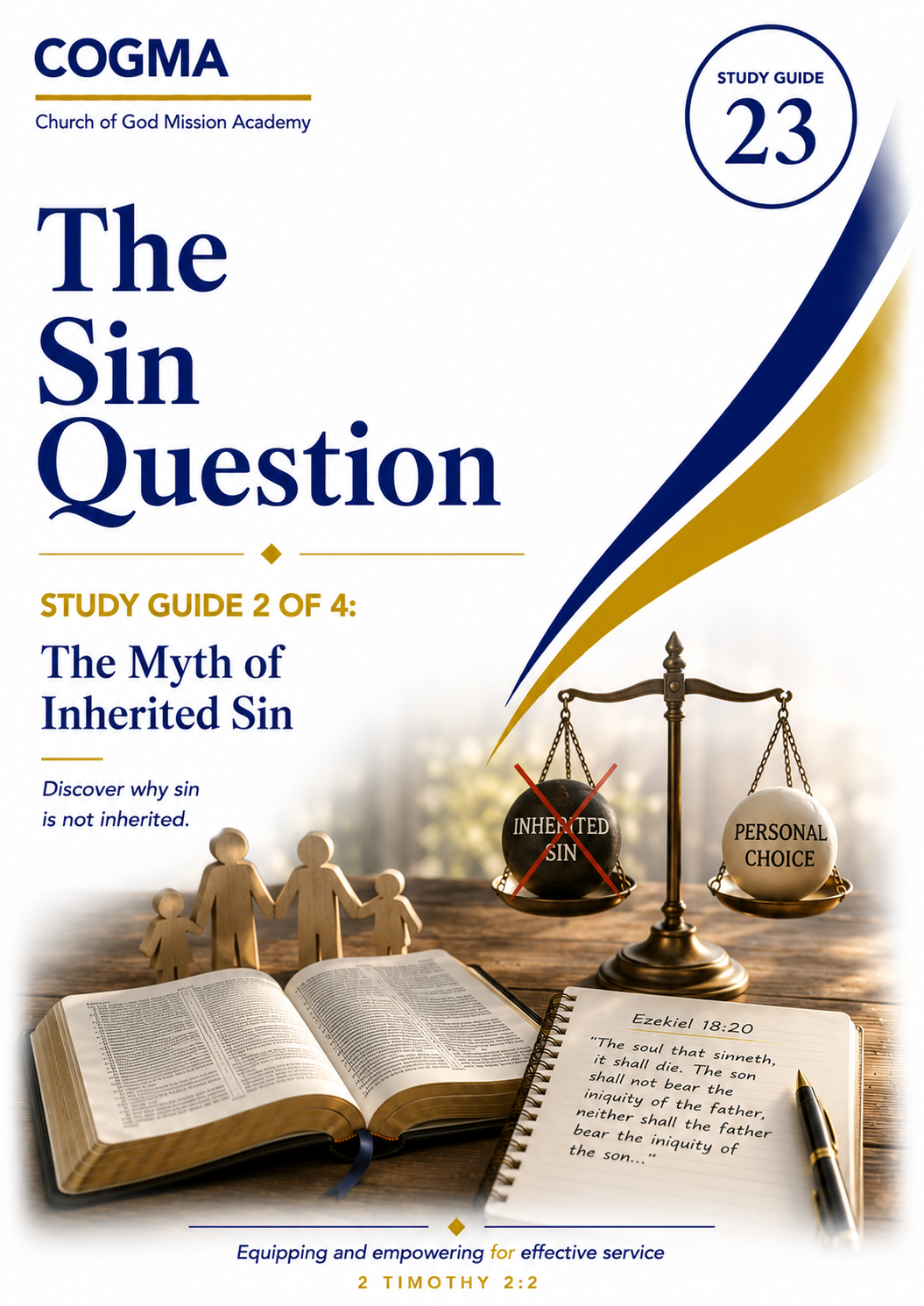
This is the second Study Guide in the series The Sin Question, continuing to explore the topic of sin from a biblical perspective.
The previous Study Guide established that while everyone can sin, followers of Jesus Christ should not. John clarifies this in his first letter.
1 John 3:6 says:
“Whosoever abideth in him sinneth not: whosoever sinneth hath not seen him, neither known him.”
Many denominations teach an "experiential religion," claiming that Christians inevitably sin daily in thought, word, and deed. These beliefs stem from personal experience rather than biblical truth. The Bible is clear: the wages of sin is death.
Although some scriptures may seem to suggest that Christians still sin, the truth becomes evident when the Golden Rule is applied — considering the context and seeking harmony throughout Scripture.
Personal Response
Key Truth
What is the main truth this Introduction has shown about how Scripture should be approached when studying sin?
Personal Reflection
Have you noticed teachings about sin in your own experience that rely more on personal feeling than on the whole counsel of Scripture?
Action Step
What is one passage about sin you will study this week using the Golden Rule — reading it in its full context rather than in isolation?
THE REASON FOR SO MANY DENOMINATIONS
Today, many question whether true Bible doctrine — or Bible truth — really matters. This is particularly striking when one considers that, according to the Centre for the Study of Global Christianity, there are over 45,000 Christian denominations in the world today.
This is a staggering number, especially when one remembers that Jesus instituted only one church — His bride — on the day of Pentecost.
i.
The Causes of Division
Why are there so many denominations? The causes are varied, but they can often be traced back to differences in belief, corruption, and man's desire for power and control.
The Apostle Paul explained that any deviation from the one church Jesus built has its root cause in carnality.
1 Corinthians 3:3 says:
“For ye are yet carnal: for whereas there is among you envying, and strife, and divisions, are ye not carnal, and walk as men?”
Paul strongly believed that there is only one church, and any division or separation from it was false and based on human nature and carnality.
ii.
Paul's Teaching on Unity
In his letter to the Ephesians, Paul emphasised the importance of unity. He made it clear that there is only one body, which is the body of Christ, also known as the church.
Ephesians 4:4 says:
“There is one body, and one Spirit, even as ye are called in one hope of your calling;”
Paul also taught that the "one body" is the church itself, as seen in another passage.
Ephesians 1:22–23 says:
“And hath put all things under his feet, and gave him to be the head over all things to the church, which is his body, the fulness of him that filleth all in all.”
It is important to study the meaning of words in their original language. The word "one" in Ephesians 4:4 is from the Greek word heis, meaning "the one and only" or the absolute number one. This emphasises the singular nature of the church as designed by God.
iii.
Divisions Even Among the “Church of God”
Even within groups that call themselves the "Church of God," divisions have occurred over the years. Since 1882, the Church of God has split into over 50 different groups. These splits have resulted from disagreements over things like how members dress, whether neckties should be worn, pastoral succession, and pastoral authority. These divisions, just like the larger denominational differences, have their roots in carnality.
iv.
Paul's Call to Preserve Unity
Paul was passionate about the church preserving its unity at all costs. He stressed the importance of "keeping the unity of the Spirit in the bond of peace."
Ephesians 4:1–2 says:
“I therefore, the prisoner of the Lord, beseech you that ye walk worthy of the vocation wherewith ye are called, with all lowliness and meekness, with longsuffering, forbearing one another in love;”
In this passage, Paul speaks of agape, the love of God, rather than human affection. This divine love empowers believers to "forbear" — or "put up with" — one another in love.
Personal Response
Key Truth
What is the main truth these sections show about the true root cause of denominational division?
Personal Reflection
Have you ever contributed to division over a matter of preference or opinion rather than a matter of biblical truth?
Action Step
What is one way you will actively "forbear" with another believer in love this week, rather than allowing a minor difference to become a division?
v.
Endeavouring to Keep Unity
Paul continues with a call to "endeavour" to maintain unity. The Greek word spoudazo used here means to make it a priority — to preserve the unity of the Spirit at all costs.
Ephesians 4:3 says:
“Endeavouring to keep the unity of the Spirit in the bond of peace.”
Paul frequently used the human body as a metaphor to explain spiritual truths. He reminds the church that just as a human body cannot function if divided, the church cannot remain the true body of Christ if it is divided.
vi.
Misconceptions About Sin and Unity
Many Christians today believe they cannot help but sin daily in thought, word, and deed. They often hold the belief that as long as they "love Jesus," nothing else matters. However, this idea contradicts what Jesus taught: "If you love me, obey me."
This belief that Christians are bound to sin is often attributed to the doctrine of original sin, or the inherited "Adamic nature." However, Paul warned that the church would face enemies both from outside and within.
Acts 20:29–30 says:
“For I know this, that after my departing shall grievous wolves enter in among you, not sparing the flock. Also of your own selves shall men arise, speaking perverse things, to draw away disciples after them.”
vii.
Key Truths
- The countless denominations that exist today have their root cause in human carnality, not in biblical truth.
- Scripture teaches there is only one church, one body, described by the Greek word heis — the one and only.
- Preserving unity is a priority, empowered by agape love and pursued through deliberate effort.
- The belief that Christians are bound to sin daily contradicts Jesus' own teaching to keep His commandments.
Personal Response
Key Truth
What is the main truth Lesson 1 has shown about the origin of denominational division and the call to unity?
Personal Reflection
Where in your own church experience have you seen carnality, rather than doctrine, driving division?
Action Step
What is one specific step you will take this week to guard the unity of the Spirit in your own relationships?
THE RISE OF GNOSTICISM
One of the internal enemies the early church faced was Gnosticism, which John confronted in his first epistle. Cerinthus, a contemporary of John, was one such teacher whose beliefs were considered heretical by orthodox Christians.
Cerinthus is associated with Gnosticism, which emphasises esoteric knowledge and often contradicts foundational Christian teaching. He taught that the world was created by a lesser divine being; that Jesus was a mere human, and the "Christ" only descended upon Him at baptism, leaving before the crucifixion; and that there would be a future golden age, which is interpreted today as a physical millennial reign of Christ.
Cerinthus's views were in direct opposition to the orthodox belief in the divine nature of Jesus and His continuous incarnation. According to tradition, John opposed Cerinthus so strongly that, upon discovering Cerinthus was in the same bathhouse, he left immediately, fearing God's judgment might destroy the building.
i.
What Is Gnosticism?
Gnosticism is a heretical movement that clashed with early Christian doctrine, leading to fierce debates within the church. By the end of the second century, many Gnostics either broke away or were expelled, forming alternative churches. Some key elements of Gnosticism include the following.
- Dualism — Gnostics believed the world was divided into the physical and spiritual realms. The material world, created by an evil lesser god, was seen as evil, while only the spiritual realm was considered good.
- God — Gnostic writings describe God as incomprehensible and unknowable, which conflicts with Christianity's concept of a personal God who desires a relationship with humanity. Gnostics also separated the inferior god of creation from the superior god of redemption.
- Salvation — Gnosticism claimed that hidden knowledge was the basis for salvation. This secret revelation was believed to free the "divine spark" within humans, allowing the soul to return to the divine realm of light. Gnostics divided Christians into two categories — carnal (inferior) and spiritual (superior) — with only the enlightened, spiritually superior individuals capable of achieving salvation.
ii.
Christianity versus Gnosticism
In contrast to Gnosticism, Christianity teaches that salvation is available to everyone through grace and faith in Jesus Christ, not through hidden knowledge or spiritual superiority.
Ephesians 2:8–9 says:
“For by grace are ye saved through faith; and that not of yourselves: it is the gift of God: Not of works, lest any man should boast.”
Furthermore, Christianity asserts the Bible as the sole source of truth, whereas Gnosticism rejected the Bible, relying instead on secret teachings. Gnostics claimed that divine knowledge was available only to a select few, while Christianity teaches that salvation is a free gift from God and not something earned through study or works.
Personal Response
Key Truth
What is the main truth these sections show about the contrast between Gnostic "hidden knowledge" and the gospel of grace?
Personal Reflection
Have you ever encountered a modern teaching that echoes the Gnostic idea of special, secret knowledge available only to a spiritual elite?
Action Step
What is one way you will affirm this week that salvation is by grace through faith, available to all, not earned through special knowledge or status?
iii.
Gnosticism's Influence on Modern Christianity
Despite the early church's strong opposition to Gnosticism, elements of Gnostic belief have persisted and influenced various strands of what is considered Christianity today. This has contributed to many schisms and divisions within the church. For example, the division between clergy and laity, stemming from the Nicolaitan spirit, reflects a separation of spiritual authority that remains prevalent in many churches today. The concept of multiple gods also has roots in the debates surrounding the nature of Jesus, particularly the idea that Jesus is a lesser god.
iv.
The Council of Nicaea and the Arian Controversy
The Arian Controversy further solidified some of these divisions. In the fourth century, a debate arose over the nature of Jesus's divinity. Arius, a priest from Alexandria, argued that Jesus was begotten by God and therefore a lesser divinity. He claimed that Jesus, although divine, was not equal to God.
On the other hand, Athanasius, also from Alexandria, argued that Jesus was God incarnate and co-equal with the Father.
The debate came to a head at the Council of Nicaea in 325 AD, convened by Emperor Constantine to settle the issue. This Study Guide holds that the council ultimately sided with Arius and introduced the idea that Jesus received the Holy Spirit at His baptism in the Jordan River, and that the Holy Spirit left Him on the cross. This belief, rooted in Gnosticism, is presented in this Study Guide as having laid the foundation for what eventually became the Roman Catholic system and, later, the Protestant religious system.
v.
The COGMA Position
COGMA holds to the belief that Jesus is God incarnate. During His earthly ministry, His spirit was the Holy Spirit and the Spirit of God. COGMA rejects the Gnostic view that Jesus was merely a human upon whom the Holy Spirit temporarily descended. Instead, COGMA affirms that Jesus was fully divine throughout His earthly life and that His ministry continues through His body — the church — during what is called the Gospel Day. The indwelling of Christ's Spirit remains with His people as they carry forward His ministry, empowered by the Holy Spirit.
Romans 8:9 says:
“But ye are not in the flesh, but in the Spirit, if so be that the Spirit of God dwell in you. Now if any man have not the Spirit of Christ, he is none of his.”
vi.
Key Truths
- Gnosticism taught salvation through hidden knowledge, in contrast to the biblical gospel of grace through faith.
- Gnostic dualism viewed the physical world as evil, a view that influenced later teaching about the inherent sinfulness of the flesh.
- The Arian Controversy and the Council of Nicaea shaped later beliefs about the nature of Christ.
- COGMA holds that Jesus was fully God incarnate throughout His earthly life, and that His Spirit continues in the church today.
Personal Response
Key Truth
What is the main truth Lesson 2 has shown about the influence of Gnosticism on Christian teaching about sin and the flesh?
Personal Reflection
How does understanding this history change the way you evaluate teachings you have heard about the sinfulness of the physical body?
Action Step
What is one teaching you have accepted that you will now examine to see whether it reflects biblical truth or a Gnostic-influenced tradition?
AUGUSTINE OF HIPPO AND THE DOCTRINE OF ORIGINAL SIN
Augustine of Hippo, born in 354 AD, is a well-known figure in Christian history, but his early life was marked by a sinful and promiscuous lifestyle. At the age of nineteen, Augustine joined the Manichaeism religious movement, which combined elements of various religious traditions, including Christianity, Zoroastrianism, and Buddhism.
i.
Key Points About Manichaeism
- Founder — Mani (c. 216–276 CE), also known as Manes or Manichaeus, was born in Mesopotamia. He founded Manichaeism in the third century CE, and the religion quickly spread throughout the Roman Empire and into Asia.
- Dualism — Manichaeism is fundamentally a dualistic belief system, positing an eternal struggle between the forces of light (good) and darkness (evil).
- Light and darkness — According to Manichaean teaching, the material world is a battleground where light is trapped within darkness. The struggle between these forces defines human existence.
- Salvation — Salvation in Manichaeism is achieved through knowledge (gnosis), ethical living, ascetic practices, and rituals that help liberate the trapped light from the darkness.
ii.
Augustine's Development of the Doctrine of Original Sin
It was during his time in Manichaeism that Augustine found what this Study Guide describes as a scapegoat for his sinful behaviour, concluding that he was simply born that way. From this idea, Augustine began to develop the doctrine now known as "Original Sin," which asserts that all people inherit a sinful nature from Adam.
This belief laid the groundwork for the following doctrines:
- Once saved, always saved — the belief that after a person is saved, their salvation is secure regardless of continued sin.
- Inability to live without sin — the teaching that humans cannot avoid sinning daily, in thought, word, or deed, because of an inherited sin nature.
Personal Response
Key Truth
What is the main truth these sections show about where the doctrine of Original Sin came from?
Personal Reflection
Does knowing the historical origin of a teaching change how carefully you examine it against Scripture?
Action Step
What is one doctrine you have accepted without tracing its origin that you will examine against Scripture this week?
iii.
The Basis of Experiential Religion
Augustine's teaching contributed to what is now referred to as "experiential religion," where personal experiences are viewed as confirmation of truth rather than relying solely on biblical doctrine. Examples include a Pentecostal claiming, "I speak in tongues like others, so this must be the evidence of receiving the Holy Spirit," or others arguing that their continued sinning, despite being Christians, is due to their inherited sin nature, thus excusing sinful behaviour.
This thinking mirrors Gnostic ideas, where the flesh is seen as inherently evil while the spirit is viewed as good. This Study Guide notes that a similar argument has been used by some to claim they are "born that way," invoking the idea that the body's desires are naturally inclined toward sin.
iv.
Augustine's Conversion and Influence
Despite his early immersion in Manichaeism, Augustine eventually renounced the movement and converted to Christianity. He became one of the most significant theologians in Christian history. His involvement in Manichaeism, however, provides insight into the religious and philosophical landscape of his time, where Gnostic ideas and dualistic beliefs challenged orthodox Christian teaching.
Although Augustine rejected Manichaeism, many of its dualistic and Gnostic elements influenced his thinking. His theology laid the framework for the Roman Catholic religious system and influenced doctrines like Original Sin and the nature of human desire. These ideas would later be used by Martin Luther during the Protestant Reformation, and Augustine's teaching continues to influence both Catholic and Protestant traditions today.
Key doctrines rooted in Augustine's thought, such as Original Sin, have become central tenets of Christian theology across various denominations. His views on human nature, grace, and salvation continue to resonate through much of what is called Christianity today.
v.
Augustine's Views on Sex and Concupiscence
Augustine's earlier indulgence in sexual pleasures and later conversion to Christianity heavily shaped his attitudes toward sex. After his conversion, he embraced asceticism — severe self-discipline avoiding all forms of indulgence — and viewed marriage and sex as necessary but lesser goods compared to celibacy.
Augustine introduced the concept of concupiscence, which he defined as the disordered desire or lust that resulted from original sin. He believed that sexual desire, even within marriage, was inherently tainted by sin. According to Augustine, original sin was transmitted through sexual intercourse, which he saw as an act driven by concupiscence. This view contributed to his negative perception of sexual desire and became central to his theology of human nature.
In other words, Augustine taught that sin was a physical disease passed from parents to children through the act of procreation. However, this belief is unbiblical. There is no Scripture to support the idea that sin can be inherited from one person to another by sexual intercourse or any other means.
Sin is not a physical condition but a spiritual disease that leads to spiritual death, and it is based on a person's individual choice to obey or disobey God.
vi.
The Nature of Sin According to Scripture
God warned Adam that on the day he disobeyed and ate from the tree of the knowledge of good and evil, he would surely die. When Adam ate the fruit, he did not die physically but spiritually, as God removed him from the Garden of Eden, which represented a type of the Kingdom of God.
Ezekiel 18:20 clearly refutes the idea of inherited sin.
Ezekiel 18:20 says:
“The soul that sinneth, it shall die. The son shall not bear the iniquity of the father, neither shall the father bear the iniquity of the son: the righteousness of the righteous shall be upon him, and the wickedness of the wicked shall be upon him.”
This verse affirms that each person is responsible for their own sin. Sin is not passed from parent to child, but is instead the result of each individual's personal choices and relationship with God.
vii.
Key Truths
- The doctrine of Original Sin traces back to Augustine of Hippo, shaped in part by his earlier involvement in Manichaean dualism.
- Augustine's teaching that sin is transmitted physically through procreation contradicts Scripture.
- Sin is a spiritual condition, not a physical disease, and it is based on personal choice.
- Ezekiel 18:20 affirms that each soul is responsible for its own sin.
Personal Response
Key Truth
What is the main truth Lesson 3 has shown about the historical and biblical status of the doctrine of Original Sin?
Personal Reflection
In what ways has Augustine's framework, even indirectly, shaped how you were taught to think about sin and the body?
Action Step
What is one specific way you will affirm this week that sin is a matter of your own choice, not an inherited condition?
PSALM 51 AND PSALM 58 — SIN IS A PERSONAL CHOICE, NOT INHERITED
i.
David's Statement in Psalm 51:5
A commonly referenced verse in discussions of original sin is Psalm 51:5, where David states:
Psalm 51:5 says:
“Behold, I was shapen in iniquity; and in sin did my mother conceive me.”
It is important to read this passage carefully as the psalmist wrote it. David does not say, "Sin was conceived in me," but rather, "In sin did my mother conceive me." This indicates that David is not suggesting that sin was inherently passed on to him at conception. Instead, he is highlighting the sinful condition of the world, and possibly of his mother's state at the time of his conception.
ii.
Sin Under the Mosaic Law
David lived under the Mosaic Law, and during this time, sin was pervasive. As Galatians 3:22 states:
Galatians 3:22 says:
“The scripture [referring to the Old Testament] hath concluded all under sin.”
This was because the sacrifices under the Mosaic Law could not fully take away sin, as explained in the book of Hebrews.
Hebrews 10:4 says:
“For it is not possible that the blood of bulls and of goats should take away sins.”
David acknowledged his personal responsibility for his sin. In Psalm 51:3-4, David explicitly takes ownership of his wrongdoing.
Psalm 51:3–4 says:
“For I acknowledge my transgressions: and my sin is ever before me. Against thee, thee only, have I sinned, and done this evil in thy sight.”
David does not claim that original sin or any inherited predisposition caused him to sin. Rather, he admits that his sin was an act of will, for which he alone was responsible.
iii.
David's Temptation and Sin: A Personal Choice
In 2 Samuel 11, we see how David fell into sin. His temptation followed the same pattern as Eve's and Jesus's temptations, described in 1 John 2:16 as "the lust of the flesh, the lust of the eyes, and the pride of life." David made a choice to sin through his own actions, not because of any sin he inherited from his parents.
Personal Response
Key Truth
What is the main truth these sections show about how Psalm 51:5 should be read in its proper context?
Personal Reflection
Have you ever used a verse like Psalm 51:5 to excuse sin as inevitable, rather than recognising it as a description of a sinful world?
Action Step
What is one specific temptation, following the pattern of the flesh, the eyes, or pride, that you will guard against this week, following David's example of taking ownership rather than blaming inheritance?
In Psalm 51:5, David seems to be drawing a metaphor between the hidden, private act of conception and the "hidden part" of man, which is the soul. In verse 6, David explains that God desires truth and honesty in the inward parts.
Psalm 51:6 says:
“Behold, thou desirest truth in the inward parts: and in the hidden part thou shalt make me to know wisdom.”
Just as conception happens in private, David had tried to hide his sin. The point is that both physical and spiritual actions that are done in secret cannot be hidden from God and will eventually be revealed. Just as the consequences of physical actions manifest, so do the spiritual consequences of hidden sins.
v.
David's Statement in Psalm 58:3
Another frequently cited verse in support of the inherited sin nature is Psalm 58:3.
Psalm 58:3 says:
“The wicked are estranged from the womb: they go astray as soon as they be born, speaking lies.”
However, interpreting this verse literally raises several questions. Is the psalmist saying that all mankind is inherently wicked? At first glance, this might seem to suggest that people are born wicked. But looking closely, it becomes clear that David is talking about specific people who were acting wickedly, not all of humanity.
vi.
Figurative Language in Psalm 58
In verse 6, David asks God to "break their teeth" — obviously not something he is asking to happen to infants. And in verse 3, where he says "as soon as they be born, speaking lies," it is evident that newborns cannot speak at all. These verses use figurative language to describe certain wicked people, not all of humanity.
The introduction to this psalm identifies it as a Michtam of David, a psalm written during David's time fleeing from Saul. This means David was speaking about the wicked people who were opposing him during that time, not making a broad statement about all humans being born sinful.
vii.
Key Truths
- Psalm 51:5 describes the sinful condition of the world into which David was born, not an inherited sin nature passed to him personally.
- David repeatedly took personal ownership of his sin as an act of his own will.
- Psalm 58:3 uses figurative language about specific wicked people, not a literal statement about all newborns.
- Sin, in both psalms, is shown to be a matter of personal choice, not inheritance.
Personal Response
Key Truth
What is the main truth Lesson 4 has shown about how Psalm 51:5 and Psalm 58:3 are properly understood?
Personal Reflection
How does reading these psalms in their full context change your understanding of what David was actually confessing?
Action Step
What is one Scripture you have heard quoted out of context that you will now go back and study in its fuller setting?
ROMANS CHAPTER 5: UNDERSTANDING THE ENTRANCE OF SIN
Romans 5 raises a question worth considering, since Paul explains that sin entered the world through one man.
Romans 5:12 says:
“Wherefore, as by one man sin entered into the world, and death by sin; and so death passed upon all men, for that all have sinned:”
When interpreting the Bible, it is important to consider the context and harmony of the Scriptures rather than focusing on a single verse in isolation.
Romans 5 can be divided into two parts: verses 1-11 discuss the blessings of salvation, and verses 12-21 explain the extent of salvation. The second part details how sin entered the world through Adam and its impact on humanity, while also describing how Jesus Christ, referred to as the "last Adam," addressed the effects of sin on humankind.
i.
The Concept of Original Sin
The idea that sin is inherited as a nature originated with Augustine of Hippo and the Roman Catholic Church in the fourth century. This concept, often called "original sin," has also been adopted by many Protestant groups as the Adamic sin nature.
The Roman Catholic Church addresses original sin through baptism or the sprinkling of holy water. Most Protestant denominations hold that original sin is inherited in the physical body and is only resolved through physical death. Many holiness denominations and churches of God believe in original sin and claim that it can be eradicated through a process called "entire sanctification."
This Study Guide holds these interpretations to be incorrect. As previously explained, the Bible does not support the idea that sin can be passed from one person to another at birth.
ii.
Romans 5:12 — Sin Entered the World, Not Mankind
In Romans 5:12, it is important to note the wording: "sin entered into the world," not into humans. If sin had entered mankind, the verse would say "by one man sin entered into mankind." This distinction is crucial.
God did not assign Adam's sin to all humanity. The following verse makes this clear. However, if a person sins like Adam did, they face the same consequences of disobedience.
Romans 5:13 says:
“(For until the law sin was in the world: but sin is not imputed when there is no law.)”
Paul's message is that everyone begins life spiritually alive and innocent before God. Sin is defined as the deliberate act of breaking God's command. For Adam, this was the command not to eat from the tree of the knowledge of good and evil. The tree itself was not poisonous, nor did eating from it cause physical death. Adam and Eve did not die physically on the day they ate from it, but they did die spiritually.
Personal Response
Key Truth
What is the main truth these sections show about the distinction between sin entering the world and sin entering mankind?
Personal Reflection
How does the wording "sin entered the world" rather than "sin entered mankind" change your understanding of Romans 5:12?
Action Step
What is one way you will explain this distinction to someone else this week who believes sin is automatically inherited?
iii.
The Passing of Death: A Choice, Not Inheritance
Romans 5:12 says:
“Wherefore, as by one man sin entered into the world, and death by sin; and so death passed upon all men, for that all have sinned:”
Paul's statement that death passed upon all men indicates that while death affects everyone, sin itself is not automatically inherited. Death affected humanity, but it did not originate within each person. Paul specifies that death did not pass through all men.
This distinction means that when someone reaches an age of accountability — the point at which they can understand God's command and the consequences of disobeying it — and they choose to sin, they experience spiritual death, just as Adam did.
iv.
Spiritual Death and Separation from God
Spiritual death refers to separation from God as a result of sin. It is important to note the difference in language here: death comes upon individuals, not through them. This happens because, like Adam, they make a choice to sin. As a result, sinners face the consequences of their actions — spiritual separation from God.
Romans 6:23 says:
“For the wages of sin is death; but the gift of God is eternal life through Jesus Christ our Lord.”
People are not born spiritually dead due to an inherited sinful nature. Instead, they become spiritually dead when they consciously and intentionally disobey God. Until that moment, they are spiritually alive.
Paul explains in Romans 7 that where there is no law, there is no sin. This means that sin cannot be counted against someone until they understand and wilfully break God's command.
v.
Sin Entering the World and Its Corrupting Principle
In Romans 5:12, Paul states that "sin entered into the world." Before Adam's sin, the world was in a perfect state. Genesis 1 confirms this when God declared His creation to be very good.
When Adam sinned, he introduced a corrupting principle into the world, which altered what was originally "very good." Before sinning, Adam and Eve were naked and unashamed, but after sinning, their eyes were opened, and they covered themselves with fig leaves, demonstrating their awareness of sin. Romans 5:12 emphasises this: Adam introduced a principle of sin into the world that corrupted all creation.
This explains why John, in his letters, warns against loving the world.
1 John 2:15 says:
“Love not the world, neither the things that are in the world. If any man love the world, the love of the Father is not in him.”
John issues this warning because, through sin, the world has become corrupt.
vi.
Key Truths
- Romans 5:12 states that sin entered the world, not that it entered every individual by inheritance.
- Death passed upon all men because all have sinned, not because sin itself was automatically transmitted.
- A person becomes spiritually dead only when they wilfully choose to disobey God at the age of accountability.
- Adam's sin introduced a corrupting principle into the world, which is why Scripture warns against love of the world.
Personal Response
Key Truth
What is the main truth Lesson 5 has shown about how sin entered the world according to Romans 5?
Personal Reflection
Do you now see spiritual death as something that comes upon a person through their own choice, rather than something automatically inherited?
Action Step
What is one specific choice before you this week where you will consciously choose obedience rather than disobedience, understanding the consequences involved?
UNDERSTANDING THE TRUE MEANING OF 1 JOHN 1:8
It is a common belief, based on 1 John 1:8, that Christians inevitably sin daily in thought, word, and action.
1 John 1:8 says:
“If we say that we have no sin, we deceive ourselves, and the truth is not in us.”
This verse is often paraphrased as "If anyone claims to be without sin, they deceive themselves, and the truth is not in them," or "If any man says he lives without sin, he is a liar, and the truth is not in him." While these paraphrases may seem accurate at first glance, it is important to apply sound biblical principles: search for answers honestly, without bias; keep context in mind and avoid focusing on one verse in isolation; look for consistency within the book, chapter, and the entire Bible; and trust that the truth remains consistent and does not contradict itself.
i.
The Purpose of John's Letter
John begins his letter by explaining why he wrote it.
1 John 1:3 says:
“That which we have seen and heard declare we unto you, that ye also may have fellowship with us: and truly our fellowship is with the Father, and with his Son Jesus Christ.”
His purpose is to invite believers into fellowship with God. This fellowship brings fullness of joy, as John clarifies.
1 John 1:4 says:
“And these things write we unto you, that your joy may be full.”
The theme of fellowship with God continues throughout the letter and reinforces the believer's call to righteousness and freedom from sin.
ii.
John's Definition of Sin
In 1 John 3:4, John defines sin.
1 John 3:4 says:
“Whosoever committeth sin transgresseth also the law: for sin is the transgression of the law.”
John is clear that sin is a deliberate act of breaking God's law, which stands in contrast to righteousness. The reason for Christ's coming was to remove sin from His people.
1 John 3:5 says:
“And ye know that he was manifested to take away our sins; and in him is no sin.”
This is consistent with what the angel told Joseph about the purpose of Christ's birth.
Matthew 1:21 says:
“And she shall bring forth a son, and thou shalt call his name JESUS: for he shall save his people from their sins.”
Note the key wording — Jesus came to save people from their sins, not in their sins. The Greek word for "from" is apo, indicating separation. Sin separates the unsaved from the saved. This is further supported by John's writing.
1 John 3:6 says:
“Whosoever abideth in him sinneth not: whosoever sinneth hath not seen him, neither known him.”
John makes it clear that those who truly abide in Christ do not continue in sin.
Personal Response
Key Truth
What is the main truth these sections show about how the Greek word apo shapes the meaning of Jesus saving people from their sins?
Personal Reflection
Have you thought of salvation more as Jesus saving you in your sin, or from your sin? How does this distinction affect your view of your own walk?
Action Step
What is one specific area of sin you will ask Christ to fully separate you from this week, rather than assuming it will always remain?
iii.
The Warning Against Deception
In case there is any doubt about the issue of sin, John offers a warning.
1 John 3:7 says:
“Little children, let no man deceive you: he that doeth righteousness is righteous, even as he is righteous.”
Here, John addresses new believers (referred to as "little children") to help them understand the importance of practising righteousness. He emphasises that righteousness is not just a status but a way of life for those in Christ. Contrary to some teachings that suggest God sees only Jesus when He looks at believers, this Study Guide affirms that God sees each person's actions and righteousness.
John goes on to clearly distinguish between those who are born again and those who are not.
1 John 3:8 says:
“He that committeth sin is of the devil; for the devil sinneth from the beginning. For this purpose the Son of God was manifested, that he might destroy the works of the devil.”
The works of the devil are identified as committing sin, and Jesus came to destroy those works.
iv.
The Clear Divide Between Believers and Sinners
1 John 3:9–10 says:
“Whosoever is born of God doth not commit sin; for his seed remaineth in him: and he cannot sin, because he is born of God. In this the children of God are manifest, and the children of the devil: whosoever doeth not righteousness is not of God, neither he that loveth not his brother.”
John highlights the impossibility of living in sin while claiming to be born of God. This separation is evident — those who are truly born of God live in righteousness, while those who commit sin are of the devil.
Paul addresses the same issue in Romans 6:1-2.
Romans 6:1–2 says:
“What shall we say then? Shall we continue in sin, that grace may abound? God forbid. How shall we, that are dead to sin, live any longer therein?”
Paul's question is rhetorical — born-again believers cannot continue living in sin. This echoes John's message that those in Christ do not continue to sin.
v.
Fullness of Joy Through Righteousness
John writes in 1 John 1:4 that he desires for believers' joy to be full. This fullness comes from living a life of righteousness, which leads to the reward of Heaven and eternal fellowship with God.
John then declares the message he personally received from Jesus.
1 John 1:5 says:
“This then is the message which we have heard of him, and declare unto you, that God is light, and in him is no darkness at all.”
The phrase "in him" refers to being "in Christ."
Ephesians 2:6 says:
“And hath raised us up together, and made us sit together in heavenly places in Christ Jesus.”
To be born again means being placed in Christ. This is further clarified by Paul.
1 Corinthians 12:13 says:
“For by one Spirit are we all baptized into one body, whether we be Jews or Gentiles, whether we be bond or free; and have been all made to drink into one Spirit.”
Paul uses different terms to describe the same spiritual truth. Being born again means being "in Christ," as described in Ephesians 2:6, and being baptized into "one body," which is the body of Christ, as reinforced in Ephesians 1:22-23.
Ephesians 1:22–23 says:
“And hath put all things under his feet, and gave him to be the head over all things to the church, Which is his body, the fulness of him that filleth all in all.”
The Bible demonstrates consistency regarding the issue of sin and righteousness. The terms "in Christ," "one body," "the body of Christ," and "the church" all describe the same spiritual place — the state of being born again and in fellowship with God.
Acts 2:47 says:
“Praising God, and having favour with all the people. And the Lord added to the church daily such as should be saved.”
To be born again is to be added to the church and placed in Christ. This spiritual position ensures that believers are no longer in darkness or sin but walk in the light and righteousness of God.
vi.
Light versus Darkness
John conveys the message he received from Jesus in his Gospel, emphasising the profound contrast between light and darkness.
John 3:19 says:
“And this is the condemnation, that light is come into the world, and men loved darkness rather than light, because their deeds were evil.”
Darkness in the Bible symbolises evil and sin, while light represents Christ and those born again, who live in righteousness. Once again, this reveals the clear divide (apo) between the saved and the unsaved.
In Colossians 1:13, Paul uses a different metaphor to describe the born-again experience.
Colossians 1:13 says:
“Who hath delivered us from the power of darkness, and hath translated us into the kingdom of his dear Son:”
A person cannot walk in darkness — that is, live in sin — and claim to walk in the light. This understanding brings the discussion back to 1 John 1:5, where John reiterates Jesus' message: God is light, and in Christ, there is no darkness. Being born again means being placed "in Christ," and in Christ, there is no room for darkness, evil, or sin.
1 John 1:6 says:
“If we say that we have fellowship with him, and walk in darkness, we lie, and do not the truth:”
No matter how much someone claims to be born again, if they continue to live in sin, they are not in true fellowship with Christ.
1 John 1:7 says:
“But if we walk in the light, as he is in the light, we have fellowship one with another, and the blood of Jesus Christ his Son cleanseth us from all sin.”
This makes it clear — darkness and light cannot coexist. Just as righteousness and unrighteousness cannot exist together in a person, salvation would be unnecessary if sin could remain. Christ came to save believers from their sins, not leave them in them, as Matthew 1:21 emphasises.
vii.
The Role of Confession
John addresses new believers in 1 John 2:1, referring to them as "little children" and encouraging them not to sin.
1 John 2:1 says:
“My little children, these things write I unto you, that ye sin not…”
John's purpose is to teach young believers that they should strive for a life free from sin. This does not contradict 1 John 1:8, which is often misunderstood as proof that Christians must sin daily.
To understand 1 John 1:8 properly, it must be read alongside the verse that follows.
1 John 1:9 says:
“If we confess our sins, he is faithful and just to forgive us our sins, and to cleanse us from all unrighteousness.”
Verses 7 and 9 clearly state that Jesus Christ's blood cleanses believers from all sin and unrighteousness if they recognise and confess their sins. 1 John 1:8 serves as a warning against self-deception — referring to the state before salvation, when a person must confess their sinful condition.
Misreading 1 John 1:8 as proof that no one can live without sin is incorrect. The surrounding verses affirm that believers can be cleansed from all sin and unrighteousness. John's entire letter reinforces the impossibility of walking in darkness (sin) while claiming to be in the light (Christ).
1 John 3:9–10 says:
“Whosoever is born of God doth not commit sin; for his seed remaineth in him: and he cannot sin, because he is born of God. In this the children of God are manifest, and the children of the devil: whosoever doeth not righteousness is not of God, neither he that loveth not his brother.”
Righteousness is the hallmark of a true disciple of Christ. A born-again believer cannot remain in sin because the very nature of righteousness excludes sin.
viii.
Clarifying “If Any Man Sin” in 1 John 2:1
1 John 2:1 says:
“My little children, these things write I unto you, that ye sin not. And if any man sin, we have an advocate with the Father, Jesus Christ the righteous.”
John uses the terms "little children," "young men," and "fathers" to refer to different levels of spiritual maturity. The phrase "if any man sin" refers to those who are still unsaved and walking in darkness, not to those who are in Christ.
John clarifies that Jesus Christ is the advocate for those who confess their sins and come into the light. This is why he encourages the new believers, "little children," to not sin. Anyone still living in darkness can find forgiveness through Christ by confessing their sins and accepting responsibility.
ix.
The Influence of Gnosticism on This Passage
It is believed that John composed his letter while addressing the rise of Gnosticism, a philosophy that was infiltrating the early church. Gnosticism, in its simplest form, taught that all matter — including the physical human body — was inherently evil, while only the spirit was good. Gnostics believed that the human spirit was a divine spark trapped within the physical body, and that salvation was achieved by freeing the spirit from this evil material existence.
A key tenet of Gnosticism was the belief that one could continue sinning in the physical body while still maintaining spiritual life with God. This teaching directly contradicted the Christian understanding of sin and salvation and led to the notion that sin in the body had no impact on one's relationship with God.
John's letter challenges this belief, emphasising that true salvation through Christ requires freedom from sin, not just in the spirit but in both the body and soul. His teaching refutes the Gnostic idea that one can persist in sin while still being alive to God.
This false doctrine is still prevalent today, with some believing that they can persist in sin and remain Christian. This belief is seen by some as particularly evident in certain religious traditions, which some critics claim promote the idea that once a person is "saved," they can continue to sin without forfeiting their status as a child of God. For many, this view of salvation suggests that it merely moderates sinful behaviour — meaning a person does not sin as much as before being saved, but still considers sin an inevitable part of life.
x.
Key Truths
- 1 John 1:8 is not proof that Christians must sin daily; it must be read together with verse 9, which promises cleansing through confession.
- Jesus came to save people from their sins (apo), not to leave them in their sins.
- John's letter consistently teaches that light and darkness — righteousness and sin — cannot coexist in a believer's life.
- This teaching directly refutes the Gnostic idea that sin in the body does not affect a person's spiritual standing before God.
Personal Response
Key Truth
What is the main truth Lesson 6 has shown about the correct meaning of 1 John 1:8 in its context?
Personal Reflection
Has this lesson changed how you would explain 1 John 1:8 to someone who uses it to excuse ongoing sin?
Action Step
What is one specific sin you will confess and turn from this week, trusting 1 John 1:9's promise of cleansing?
ROMANS CHAPTER 7: UNDERSTANDING PAUL'S STRUGGLE WITH SIN
Some who continue to sin but claim to be believers often find comfort in Romans chapter 7, interpreting it as Paul describing his own struggle with sin, even after becoming a Christian. They focus on verses such as the following.
Romans 7:15–17 says:
“For that which I do I allow not: for what I would, that do I not; but what I hate, that do I. If then I do that which I would not, I consent unto the law that it is good. Now then it is no more I that do it, but sin that dwelleth in me.”
This passage is often misunderstood to mean that Paul, as a born-again believer, was still bound to sin and unable to break free. However, this interpretation contradicts Paul's earlier testimony in Romans chapter 6, where he clearly teaches that Christians are to live free from sin.
Romans 6:1–2 says:
“What shall we say then? Shall we continue in sin, that grace may abound? God forbid. How shall we, that are dead to sin, live any longer therein?”
Paul emphasises that born-again believers are dead to sin. Just as a dead person no longer participates in life, a true believer cannot continue to live in sin. This concept of being "dead to sin" is central to Paul's teaching that sin no longer has control over those who are in Christ. Paul uses the analogy of a grave to make this point — when someone is dead, they are completely separated from life, just as believers are separated from sin.
i.
A Contradiction in Misinterpretation
The idea that Paul is describing an ongoing struggle with sin in Romans 7 stands in direct contrast with the message in Romans 6. In Romans 6, Paul clearly says that Christians should not continue in sin.
Romans 6:6–7 says:
“Knowing this, that our old man is crucified with him, that the body of sin might be destroyed, that henceforth we should not serve sin. For he that is dead is freed from sin.”
If Paul is teaching in Romans 6 that Christians are dead to sin, it would be inconsistent for him to then imply in Romans 7 that believers are still bound to sin. This would make Paul's message inconsistent, akin to the scribes and Pharisees Jesus called hypocrites.
Personal Response
Key Truth
What is the main truth these sections show about the tension between reading Romans 7 as ongoing struggle versus reading it in harmony with Romans 6?
Personal Reflection
Have you leaned on Romans 7 to explain away continued sin in your own life, without considering its harmony with Romans 6?
Action Step
What is one way this week you will remind yourself that you are "dead to sin" rather than still its servant?
ii.
Harmonising Scripture: Context Matters
Believers must be careful not to isolate verses and apply them to fit personal experiences or struggles. Instead, Scripture should be harmonised, understanding that God's Word is consistent from Genesis to Revelation.
Romans 6:11 says:
“Likewise reckon ye also yourselves to be dead indeed unto sin, but alive unto God through Jesus Christ our Lord.”
This means believers should count themselves dead to sin and alive in Christ. Paul is teaching that sin no longer has dominion over a believer's life. Therefore, interpreting Romans 7 as Paul saying Christians will always be slaves to sin misrepresents the message of the Gospel.
iii.
Romans 7 Describes Life Before Salvation
Romans chapter 7 describes Paul's life before being born again, under the Old Covenant, while still living under the Mosaic Law. His aim is to explain the difference between life under the law and life in Christ. He begins by addressing his Jewish brethren.
Romans 7:1 says:
“Know ye not, brethren, (for I speak to them that know the law,) how that the law hath dominion over a man as long as he liveth?”
Paul is speaking to those who are familiar with the Mosaic Law and who have not yet accepted Jesus Christ. Under the Old Covenant, the focus was on external adherence to the law, but the law itself was incapable of delivering people from sin.
Romans 7:5 says:
“For when we were in the flesh, the motions of sins, which were by the law, did work in our members to bring forth fruit unto death.”
Paul describes how the law highlighted sin but could not overcome it, ultimately leading to spiritual death. The law served as a guide, a "schoolmaster" to lead the Jewish people to Christ.
Galatians 3:24 says:
“Wherefore the law was our schoolmaster to bring us unto Christ, that we might be justified by faith.”
The law was a temporary measure meant to guide people to Christ, who would ultimately fulfil the law and enable believers to live in newness of spirit.
iv.
Freedom in Christ
Paul contrasts his former life under the law with the new life in Christ.
Romans 7:6 says:
“But now we are delivered from the law, that being dead wherein we were held; that we should serve in newness of spirit, and not in the oldness of the letter.”
In Christ, believers are delivered from the law's bondage. Paul makes it clear that, as believers, they now serve God in the newness of the Spirit, not through the old external adherence to the law. This "newness of spirit" is the result of being born again in Christ, empowered by the Holy Spirit to live righteously.
v.
Misinterpreting Paul's Struggle
To claim that Paul, as a born-again believer, could not avoid sinning daily in thought, word, and deed contradicts not only his teaching but also his personal testimony. Paul lived a righteous life following Christ and encouraged others to do the same.
1 Corinthians 11:1 says:
“Be ye followers of me, even as I also am of Christ.”
He viewed his life as fully surrendered to Christ.
Philippians 1:21 says:
“For to me to live is Christ, and to die is gain.”
Paul consistently urged believers to follow his example in living righteously and pursuing Christlikeness.
Philippians 3:17 says:
“Brethren, be followers together of me, and mark them which walk so as ye have us for an ensample.”
Paul's teaching and life demonstrate that it is not only possible to live free from sin, but it is the very calling of a believer. His testimony in Galatians 2:20 reinforces this.
Galatians 2:20 says:
“I am crucified with Christ: nevertheless I live; yet not I, but Christ liveth in me: and the life which I now live in the flesh I live by the faith of the Son of God, who loved me, and gave himself for me.”
vi.
The Law's Insufficiency and Christ's Power
Paul's struggle in Romans 7 illustrates that the law was insufficient to deliver people from sin. The law made people aware of their sinfulness but provided no power to overcome it. Paul contrasts this with the sufficiency of Christ.
Hebrews 7:19 says:
“For the law made nothing perfect, but the bringing in of a better hope did; by the which we draw nigh unto God.”
Romans 8:3 says:
“For what the law could not do, in that it was weak through the flesh, God sending his own Son in the likeness of sinful flesh, and for sin, condemned sin in the flesh.”
Through Christ, believers are no longer bound by sin or the law, because Christ condemned sin in the flesh, enabling them to live above sin.
vii.
Romans 7 as a Parenthesis
Romans chapter 7 should be viewed as a parenthesis — a digression from the primary subjects of Romans chapters 6 and 8. Without chapter 7, Paul's letter would still flow coherently, focusing on freedom from sin through Christ. In Romans 6, Paul emphasises that believers are dead to sin. In Romans 8, he continues by stating that there is no condemnation for those who are in Christ, walking after the Spirit. Romans 7 provides a historical context of life under the law, showing the futility of trying to serve God without the power of salvation through Christ.
viii.
Key Truths
- Romans 7 describes Paul's life before salvation, under the law, not an ongoing struggle after being born again.
- Romans 6 and Romans 8 together show that believers are dead to sin and free from condemnation in Christ.
- The law could make people aware of sin but had no power to deliver them from it.
- Paul's own testimony and life demonstrate that living free from sin is the believer's calling, not an impossibility.
Personal Response
Key Truth
What is the main truth Lesson 7 has shown about the correct place of Romans 7 within Paul's argument?
Personal Reflection
Has Romans 7 ever been a passage you leaned on to excuse ongoing sin? How does seeing it as describing life under the law change that?
Action Step
What is one way you will remind yourself this week that, in Christ, you are delivered from the law's bondage and empowered to serve in newness of spirit?
THE TRUE ORIGIN OF SIN
In both the secular and religious worlds, people often avoid taking responsibility for their actions, preferring to blame someone or something else. When it comes to sin, common explanations include a pre-Adamic race being responsible for sin, fallen angels influencing humanity, claiming "the devil made me do it," or believing in an inherited "Adamic sin nature" passed down through physical birth.
Contrary to these beliefs, the Bible teaches that the origin of sin in one's life lies within oneself. It emphasises personal responsibility and accountability for sin, and without Christ, one faces the consequences of sin.
Romans 6:23 says:
“For the wages of sin is death; but the gift of God is eternal life through Jesus Christ our Lord.”
The penalty for sin is spiritual death, but God's gift of eternal life through Christ is available to all who choose to receive it. Avoiding this penalty is possible only by accepting God's gift through Jesus.
i.
Personal Responsibility for Sin
Another critical verse to consider when understanding the origin of sin is Ezekiel 18:4.
Ezekiel 18:4 says:
“Behold, all souls are mine; as the soul of the father, so also the soul of the son is mine: the soul that sinneth, it shall die.”
This verse is a direct declaration from the Lord, showing that every person is responsible for their own actions. A soul must be spiritually alive before it can die, indicating that each person starts life upright and spiritually alive.
Ecclesiastes 7:25 says:
“Lo, this only have I found, that God hath made man upright; but they have sought out many inventions.”
Adam was created upright, innocent, and spiritually alive. He was formed from the dust of the earth and became a living soul by God's breath. This is true for all humans at birth.
Job 33:4 says:
“The Spirit of God hath made me, and the breath of the Almighty hath given me life.”
This process of receiving life through God's breath applies to all humans. At birth, every individual is innocent and spiritually alive. While human bodies come from the earth, human spirits come from God.
Ecclesiastes 12:7 says:
“Then shall the dust return to the earth as it was: and the spirit shall return unto God who gave it.”
This confirms that the spirit originates from God and returns to Him upon death.
Personal Response
Key Truth
What is the main truth these sections show about the spiritual condition every person is born into?
Personal Reflection
How does knowing that you began life spiritually alive and upright, rather than condemned by inheritance, change how you view your own accountability before God?
Action Step
What is one way you will take full personal responsibility this week for a specific choice, rather than attributing it to circumstance or nature?
ii.
The Perfection of Creation
God's creation was perfect, including humanity, which He declared "very good."
Genesis 1:31 says:
“And God saw every thing that he had made, and, behold, it was very good.”
The breath that brought life to Adam is the same breath that gives life to every human.
James 1:17 says:
“Every good gift and every perfect gift is from above, and cometh down from the Father of lights, with whom is no variableness, neither shadow of turning.”
Sin did not come from God's creation. It came from human choice.
iii.
Choice and Responsibility
Humans are unique in creation because they are given the power of choice. This choice defines a person's relationship with God.
Joshua 24:15 says:
“And if it seem evil unto you to serve the LORD, choose you this day whom ye will serve; whether the gods which your fathers served that were on the other side of the flood, or the gods of the Amorites, in whose land ye dwell: but as for me and my house, we will serve the LORD.”
God desires for people to know Him and make the conscious choice to serve Him, not out of compulsion but from love and commitment.
iv.
The Test of Love Through Obedience
Choice is the test of love. God gave Adam and Eve a rule to follow in the Garden of Eden, placing before them two trees: the tree of life and the tree of the knowledge of good and evil. Adam had the power to choose, but he chose disobedience, resulting in spiritual death.
Ezekiel 18:4 confirms that the soul that sins will die, placing the responsibility for sin on the individual. Romans 6:23 and Ephesians 2:8 further emphasise that salvation is God's gift, offered through Christ, but it must be received by choice.
v.
How Is Salvation Received?
The key to salvation is accepting responsibility for sin and choosing to follow Christ. On the day of Pentecost, the people who heard Peter preach were convicted and asked how to be saved. Peter instructed them to repent and be baptised. This is how salvation is received — through repentance and acknowledging sin, followed by accepting Christ's sacrifice.
Each person is the origin of their own sin — it is not inherited from Adam, nor forced by the devil. The devil may tempt, but the choice to sin lies within the individual.
vi.
Key Truths
- Every person begins life spiritually alive, upright, and innocent, made in God's image.
- Sin did not originate in God's creation, which was declared very good, but comes from human choice.
- God gives every person the power of choice, and this choice is the test of love and obedience.
- Salvation is received through repentance, confession of sin, and accepting Christ's sacrifice.
Personal Response
Key Truth
What is the main truth Lesson 8 has shown about who is truly responsible for sin in a person's life?
Personal Reflection
Have you tended to shift responsibility for sin onto something outside yourself — nature, circumstance, or the devil — rather than owning your own choices?
Action Step
What is one specific choice you are facing where you will exercise the freedom of choice God has given you, choosing obedience over disobedience?
SUMMARY: THE SIN QUESTION (PART 2)
This Study Guide has provided a comprehensive exploration of sin from a biblical perspective, emphasising the distinction between sin as a choice and common misconceptions that suggest it is an unavoidable part of the human condition. It has challenged the widespread teaching that Christians inevitably sin daily, arguing that this belief is rooted more in personal experience than in biblical truth.
1 John 3:6 says:
“Whosoever abideth in him sinneth not: whosoever sinneth hath not seen him, neither known him.”
i.
Critique of the Doctrine of Original Sin
This Study Guide has examined the origins of sin, particularly critiquing the doctrine of original sin, which claims that humanity inherits a sinful nature from Adam. It has asserted that sin is not passed down through birth or physical means but is a personal choice made by individuals when they disobey God. This perspective is supported by Ezekiel 18:20, which emphasises personal responsibility for sin.
Ezekiel 18:20 says:
“The soul that sinneth, it shall die. The son shall not bear the iniquity of the father, neither shall the father bear the iniquity of the son: the righteousness of the righteous shall be upon him, and the wickedness of the wicked shall be upon him.”
By focusing on personal accountability, this Study Guide has challenged the idea that people are born inherently sinful, and instead highlighted the individual responsibility of every person to choose righteousness.
ii.
Addressing Doctrinal Divisions
This Study Guide has also examined the issue of doctrinal divisions within Christianity, attributing the existence of thousands of denominations to human carnality and a departure from the singular church instituted by Jesus. It has underscored the importance of unity in the body of Christ, pointing to Paul's teaching on this matter.
1 Corinthians 12:12–13 says:
“For as the body is one, and hath many members, and all the members of that one body, being many, are one body: so also is Christ. For by one Spirit are we all baptized into one body…”
This passage emphasises the need for spiritual oneness within the church, reflecting the unity that Christ desires among His followers.
iii.
The Influence of Gnosticism and Augustine
This Study Guide has examined the influence of Gnosticism and Augustine of Hippo on modern Christian thought. It has noted how early heresies such as Gnosticism and dualistic thinking have left a lasting impact on contemporary theology. It has specifically critiqued Augustine's doctrine of original sin, highlighting how his ideas were shaped by his prior involvement in Manichaeism, a belief system that emphasises a dualistic struggle between good and evil.
This Study Guide has argued that these early influences have persisted, shaping both Catholic and Protestant teaching on sin. Augustine's concept of original sin has been scrutinised as unbiblical, and this Study Guide has encouraged a return to the biblical view of sin as a personal responsibility rather than an inherited condition.
iv.
Empowered to Live Free from Sin
Ultimately, this Study Guide has called believers to embrace a biblical view of sin that sees it as a matter of personal choice. It has urged Christians to live in righteousness, free from the bondage of sin, and empowered by the Holy Spirit. The focus has been on personal holiness, consistent with the teaching of both Paul and John, who emphasise that believers are called to live in freedom from sin.
Romans 6:14 says:
“For sin shall not have dominion over you: for ye are not under the law, but under grace.”
By rejecting the idea that sin is inevitable, this Study Guide has encouraged believers to walk in the light of Christ, living lives that reflect the transformative power of grace and the Holy Spirit.
Personal Response
Key Truth
What is the single most important truth this Study Guide has shown about the true origin of sin and personal responsibility?
Personal Reflection
Looking back over this Study Guide, which teaching most challenged or reshaped your previous understanding — the historical origins of Original Sin, or the specific scriptures used to defend it?
Action Step
What is one specific, ongoing change you will make in how you understand and take responsibility for sin as a result of this Study Guide?
SUBMISSION TO COGMA FOR APPRAISAL
Instructions
Complete this section after you have finished the Study Guide. It must be completed online. The link to the online form that you must complete and submit is located at the bottom of this Study Guide.
Your answers should reflect your understanding, your personal response, and how you intend to live by the truth you have studied.
Answer honestly and be specific.
1. Main Truth
What is the most important truth you have taken from this Study Guide about whether sin is inherited from Adam or the result of personal choice?
2. Understanding
In your own words, explain why Paul's wording in Romans 5:12 — that sin entered ‘the world’ rather than ‘mankind’ — is significant, and how this affects the doctrine of Original Sin.
3. Personal Reflection
What has this Study Guide revealed about your own past assumptions regarding where the doctrine of Original Sin came from, and whether you had ever traced it back to Augustine of Hippo and his time in Manichaeism?
4. Response to Truth
Which teaching in this Study Guide most challenged or corrected your previous thinking — whether it was the historical origin of Original Sin in Augustine's doctrine of concupiscence, the true meaning of Psalm 51:5, the proper reading of 1 John 1:8 alongside verse 9, or Romans 7 as a description of life before salvation rather than an ongoing struggle? Explain why it was challenging and what has changed in your understanding.
5. Action Step (Required)
Describe one specific practical action you have taken or are planning to take to stop excusing a particular sin as ‘inherited’ or ‘inevitable,’ taking full personal responsibility for it instead, as a direct result of studying this material.
6. Early Response (Required)
Have you already begun to view a specific area of sin in your life as a matter of personal choice rather than inherited nature? Answer Yes or Not yet, and then explain: if yes, what has changed; if not yet, what has prevented you from starting.
7. Ongoing Practice
What specific practice will you continue to cultivate in your life as a result of this study? This could relate to guarding the unity of the Spirit (Ephesians 4:3), confessing sin promptly as taught in 1 John 1:9, or examining teachings you hear against Scripture rather than personal experience.
8. Doctrinal Clarity
Which key doctrine or truth from this Study Guide do you now understand more clearly? This might include the meaning of HEIS in Ephesians 4:4, the meaning of APO in Matthew 1:21 and 1 John, the distinction between Romans 6, 7, and 8, or the biblical basis in Ezekiel 18:4 and 18:20 for personal responsibility over inherited guilt. Explain the difference between your previous understanding and your understanding now.
9. Living the Truth
There is a difference between knowing that sin is a personal choice and not an inherited condition, and actually living as though every temptation you face is a decision you alone are responsible for. Describe one specific area of your life where you find this gap most challenging, and explain how you intend to close it.
10. Final Response
As you complete this Study Guide and prepare for the next module, The Cause of the Gospel, which will explore further why ‘all have sinned and fall short of the glory of God,’ what is one thought, question, or area of growth that you want to continue thinking about or exploring?
You must submit your answers to the above 10 questions ONLINE.
Use the link below for your final submission after finishing this Study Guide. Answer honestly and be specific.
Would you prefer a printable copy?