
Search results will appear as highlighted text.
Quick Navigation
INTRODUCTIONSERVICESERVICE (CONTINUED): ACTIVE PARTICIPATION AND REASONABLE SERVICEBECOMING A LIVING SACRIFICESERVING OTHERSOPPORTUNITIES TO SERVE OTHERSSTEWARDSHIPSTEWARDSHIP (CONTINUED): GOD IS THE OWNERYOU ARE NOT YOUR OWNTHE REWARD OF FAITHFUL STEWARDSHIPGIVINGGIVING (CONTINUED): GIVING TO RECEIVE MOREGOD IS A REWARDERTHE ACT OF GIVINGTESTING GOD THROUGH GIVINGTITHINGGIVING IN THE NEW TESTAMENTGIVING WITH THE RIGHT MOTIVE AND ATTITUDESUMMARYSUBMISSION TO COGMA FOR APPRAISAL
INTRODUCTION
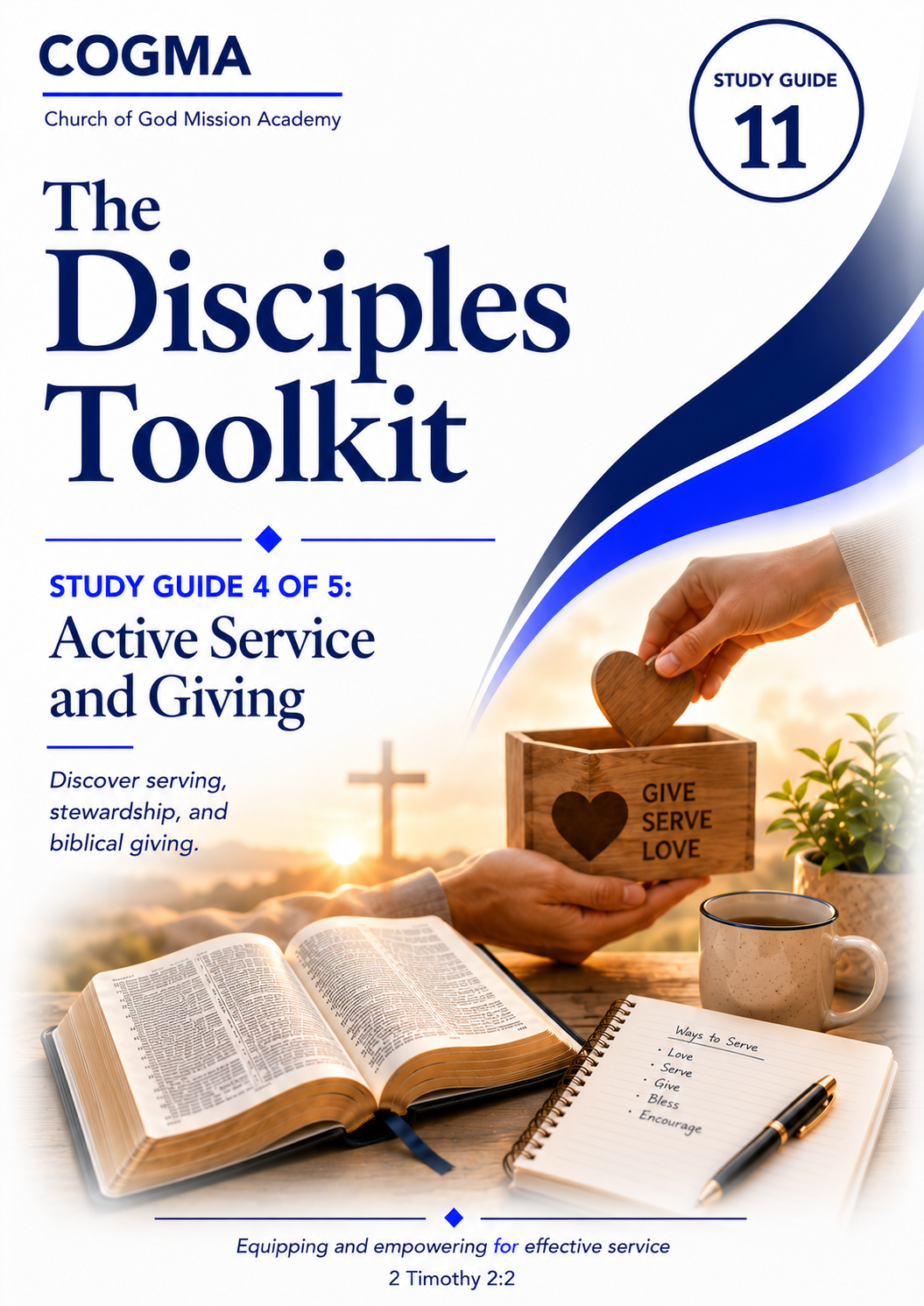
In this Study Guide, we will explore additional important tools in the Disciple’s Toolkit: service, stewardship, and giving. These tools should stem from a heart of servanthood, as demonstrated by Christ through His life and sacrificial death over two thousand years ago.
While some think that happiness comes from being served and having what they desire, the Scriptures teach us the opposite.
Acts 20:35 says:
“I have shewed you all things, how that so labouring ye ought to support the weak, and to remember the words of the Lord Jesus, how he said, It is more blessed to give than to receive.”
The Blessing of Giving
Giving does not just mean giving money. It can also mean giving your time, presence, and spirit. Think about Paul the apostle, who wanted to give something intangible.
Romans 1:11 says:
“For I long to see you, that I may impart unto you some spiritual gift, to the end ye may be established.”
Paul desired to impart spiritual gifts to the believers, demonstrating that giving is not limited to material things but can include sharing spiritual wisdom, encouragement, or support.
Trusting God’s Provision
When considering the giving of your time and money, you may fear there will not be enough left for your own needs, desires, and purposes. However, the Scriptures provide this assurance.
Proverbs 19:17 says:
“He that hath pity upon the poor lendeth unto the LORD; and that which he hath given will he pay him again.”
The poor in this context can be those who lack spiritual wealth and need Christ; those who face financial hardship despite their hard work and require assistance; or individuals seeking guidance in understanding God’s Word.
Regardless of who they are, God offers you the chance to serve them. When you show compassion and give of yourself, it is like lending to the Lord, and He promises to bless you in return.
Stewardship: Managing God’s Gifts
As a disciple of Christ, you are entrusted with resources, time, talents, and treasures, that God has blessed you with. Stewardship means managing these resources faithfully and wisely to glorify God and bless others.
Luke 16:10 says:
“He that is faithful in that which is least is faithful also in much: and he that is unjust in the least is unjust also in much.”
Being faithful in small things reflects a heart that is ready for greater responsibilities. Stewardship extends beyond financial matters to how you spend your time, use your abilities, and care for others.
The Call to Active Service
This Study Guide on active service and giving will demonstrate various ways you can share from the abundance God has blessed you with. Whether it is your time, your talents, or your treasures, God promises blessings in return for your faithful service.
When you engage in service, stewardship, and giving, you not only reflect the heart of Christ, but you also grow in your faith and experience the joy that comes from serving others.
In conclusion, remember the words of Jesus:
Matthew 25:40 says:
“And the King shall answer and say unto them, Verily I say unto you, Inasmuch as ye have done it unto one of the least of these my brethren, ye have done it unto me.”
Your service to others is ultimately service to the Lord.
Personal Response
Key Truth
Service, stewardship, and giving are tools in the Disciple’s Toolkit that flow from a heart of servanthood like Christ’s, and your service to others, no matter how small, is ultimately service to the Lord Himself.
Personal Reflection
Which of the three tools introduced here, service, stewardship, or giving, do I currently practise most naturally, and which feels least developed in my life?
Action Step
Identify one specific person this week, the poor in spirit, in finances, or in understanding, whom God is offering you the chance to serve.
SERVICE
You might have heard people refer to a church service or worship service, but strictly speaking, this can be misleading. The term service does not refer to a location but rather to an action. If you went to a church gathering and neither gave nor received anything, where is the service in that?
What Is Service in the Kingdom of God?
One of the key indicators that you have been born again is the desire and necessity to serve others. Service in the Kingdom of God goes beyond mere attendance at church or fellowship meetings. It involves actively contributing to the spiritual growth of others and the advancement of God’s work.
Jesus exemplified this spirit of servanthood when He washed His disciples’ feet, performing a task usually reserved for servants. After washing their feet, He asked if they understood the significance of His actions.
John 13:13–16 says:
“Ye call me Master and Lord: and ye say well; for so I am. If I then, your Lord and Master, have washed your feet; ye also ought to wash one another’s feet. For I have given you an example, that ye should do as I have done to you. Verily, verily, I say unto you, The servant is not greater than his lord; neither he that is sent greater than he that sent him.”
Jesus’ action was not just about washing their feet but demonstrating His Spirit. He showed that when His Spirit lives in us, we have an inner drive to serve others. This is what true Christian service looks like, humbly meeting the needs of others.
Service in a Fellowship Gathering
When you attend a fellowship meeting, your heart’s intent should be to serve God and others. Simply sitting as an observer does not reflect the heart of a servant. Active participation is essential.
There are several ways to serve in fellowship: serving God through worship, expressed in prayer, praise, and singing; giving tithes and offerings, an act of worship and service to God’s Kingdom; sharing testimonies, edifying others by telling what God has done in your life; and praying for others, serving by interceding for the needs of fellow believers.
This kind of service is not only worship to God but also strengthens and encourages the body of Christ.
1 Thessalonians 5:11 says:
“Wherefore comfort yourselves together, and edify one another, even as also ye do.”
To edify means to build up and provide strength and courage to others. It is like cheering on a runner during the middle of a long race, giving them the boost they need to finish strong.
Personal Response
Key Truth
Service in the Kingdom of God is an action, not a location, demonstrated when Jesus washed His disciples’ feet to show that His Spirit living in us produces an inner drive to humbly serve others, whether through worship, giving, testimony, or intercession.
Personal Reflection
When I attend a fellowship gathering, do I come with an active mindset of giving and serving, or do I tend to sit as a passive observer?
Action Step
At your next fellowship gathering, intentionally practise one specific way of serving listed here, whether sharing a testimony, praying for someone, or participating fully in worship.
SERVICE (CONTINUED): ACTIVE PARTICIPATION AND REASONABLE SERVICE
The Importance of Active Participation
Active participation in fellowship is vital. During a church gathering, everyone present is encouraged, strengthened, and uplifted through the preaching and teaching of God’s Word.
Colossians 3:16 says:
“Let the word of Christ dwell in you richly in all wisdom; teaching and admonishing one another in psalms and hymns and spiritual songs, singing with grace in your hearts to the Lord.”
As a disciple of Christ, it is important not to forsake these opportunities to gather and grow with fellow believers.
Hebrews 10:25 says:
“Not forsaking the assembling of ourselves together, as the manner of some is; but exhorting one another: and so much the more, as ye see the day approaching.”
Serving Through Encouragement and Instruction
Exhorting includes actions like encouraging, strengthening, and comforting one another. It also involves teaching and instructing others in God’s ways. As you grow spiritually, you will see opportunities to serve others in these ways.
When we serve others with the right spirit, we help build God’s Kingdom, contribute to the spiritual growth of others, and experience personal spiritual development as well. Every time you gather with fellow believers, remember to bring a heart of service, reflecting Christ’s servant heart to those around you.
Your Reasonable Service
In his letter to the Romans, Paul reminded believers that they were to be a living sacrifice, which he described as their reasonable service.
Romans 12:1 says:
“I beseech you therefore, brethren, by the mercies of God, that ye present your bodies a living sacrifice, holy, acceptable unto God, which is your reasonable service.”
In the Old Testament, animals were sacrificed as a foreshadowing of the ultimate sacrifice to come, Jesus Christ Himself. Jesus is the one sacrifice for all, for all time.
Hebrews 10:9–12 says:
“Then said he, Lo, I come to do thy will, O God. He taketh away the first, that he may establish the second. By the which will we are sanctified through the offering of the body of Jesus Christ once for all. And every priest standeth daily ministering and offering oftentimes the same sacrifices, which can never take away sins: But this man, after he had offered one sacrifice for sins for ever, sat down on the right hand of God.”
Indeed, the sacrifice of animals in burnt offerings could never fully satisfy God. David realised this and expressed it in Psalm 51.
Psalm 51:15–16 says:
“O Lord, open thou my lips; and my mouth shall shew forth thy praise. For thou desirest not sacrifice; else would I give it: thou delightest not in burnt offering.”
The sacrifice God desires is not animals or rituals but a humble, repentant, and obedient heart.
Psalm 51:17 says:
“The sacrifices of God are a broken spirit: a broken and a contrite heart, O God, thou wilt not despise.”
Personal Response
Key Truth
True service flows from active participation and a reasonable service of presenting your body as a living sacrifice, since the sacrifice God truly desires is not ritual but a humble, repentant, and obedient heart.
Personal Reflection
Have I treated my attendance at fellowship gatherings as a reasonable service of giving myself, or merely as a duty to fulfil?
Action Step
Examine your own heart this week, as David did in Psalm 51, and bring before God any area where ritual has replaced genuine humility and obedience.
BECOMING A LIVING SACRIFICE
What God requires from you now is to present your body as a living sacrifice. This means offering your whole self, your life, desires, plans, goals, and abilities, to Him. Salvation involves completely surrendering to God, becoming a living sacrifice acceptable in His sight. Paul emphasised this in his letter to the Corinthians.
1 Corinthians 6:19–20 says:
“What? know ye not that your body is the temple of the Holy Ghost which is in you, which ye have of God, and ye are not your own? For ye are bought with a price: therefore glorify God in your body, and in your spirit, which are God’s.”
As God’s servant, you no longer live for yourself, pursuing selfish desires. Instead, you become a living sacrifice, dedicating your life to serving God and doing what pleases Him.
You may worry that a life of sacrifice is too difficult. However, Paul reassures us that God’s expectations are reasonable. God is not a harsh taskmaster but does require wholehearted commitment. The term reasonable means both rational and sensible. God’s Word is logical and designed for your benefit.
Offering Sacrifices of Thanksgiving
Considering all that God has done for you and the many blessings He has given, it is only reasonable to offer thanksgiving in return.
Psalm 107:21–22 says:
“Oh that men would praise the LORD for his goodness, and for his wonderful works to the children of men! And let them sacrifice the sacrifices of thanksgiving, and declare his works with rejoicing.”
The Example of Christ’s Servanthood
Jesus serves as the perfect example of servanthood. Though He is equal with God, He humbled Himself and took on the form of a servant to give His life for humanity.
Philippians 2:6–8 says:
“Who, being in the form of God, thought it not robbery to be equal with God: But made himself of no reputation, and took upon him the form of a servant, and was made in the likeness of men: And being found in fashion as a man, he humbled himself, and became obedient unto death, even the death of the cross.”
Jesus came to give, not to take. He came to serve, not to be served.
Mark 10:45 says:
“For even the Son of man came not to be ministered unto, but to minister, and to give his life a ransom for many.”
Jesus exemplifies a life of service to God. As a disciple of Christ, you must serve, edify the body of Christ, and minister strength and courage to your brothers and sisters. Living a life of service, like Christ, is your reasonable service to God, reflecting His love and selflessness through every act of kindness, compassion, and sacrifice.
Personal Response
Key Truth
Christ, though equal with God, humbled Himself and took the form of a servant, coming to give rather than to take and to serve rather than to be served, establishing the perfect example for your own reasonable service.
Personal Reflection
In what specific area of my life have I been pursuing selfish desires rather than living as a dedicated, living sacrifice to God?
Action Step
Follow Christ’s example this week by identifying one opportunity to give rather than take, and to serve rather than be served, in a relationship close to you.
SERVING OTHERS
Worship without service is meaningless. Often, the Bible connects the words worship and serving. As you truly worship God in spirit and truth, you will feel compelled to enter into His service and minister to others. You will soon realise that your purpose in God’s kingdom is to replicate yourself, bringing others to experience God’s goodness and receive His salvation.
Jesus’ last words to His disciples before ascending to glory are known as the Great Commission.
Matthew 28:19–20 says:
“Go ye therefore, and teach all nations, baptizing them in the name of the Father, and of the Son, and of the Holy Ghost: Teaching them to observe all things whatsoever I have commanded you: and, lo, I am with you alway, even unto the end of the world. Amen.”
The same words are echoed in the Gospel of Mark.
Mark 16:15 says:
“And he said unto them, Go ye into all the world, and preach the gospel to every creature.”
Luke, the physician, recorded Jesus’ final instructions in the book of Acts.
Acts 1:8 says:
“But ye shall receive power, after that the Holy Ghost is come upon you: and ye shall be witnesses unto me both in Jerusalem, and in all Judaea, and in Samaria, and unto the uttermost part of the earth.”
Witnessing Through Service
As a disciple of Jesus Christ, God requires you to be His witness, teaching others about His lovingkindness and tender mercies through both words and deeds. As part of the body of Christ, His people serve as His hands and feet, acting as Jesus would.
The New Testament provides numerous examples of service to others, showing how you should represent Jesus Himself through your actions.
Mark 9:41 says:
“For whosoever shall give you a cup of water to drink in my name, because ye belong to Christ, verily I say unto you, he shall not lose his reward.”
Jesus taught that helping and ministering to the hungry, poor, sick, and imprisoned is akin to ministering to Him.
Matthew 25:40 says:
“And the King shall answer and say unto them, Verily I say unto you, Inasmuch as ye have done it unto one of the least of these my brethren, ye have done it unto me.”
Personal Response
Key Truth
Your purpose in God’s kingdom is to replicate yourself, bringing others to experience God’s goodness, and Jesus taught that helping and ministering to the hungry, poor, sick, and imprisoned is the same as ministering directly to Him.
Personal Reflection
Do I see acts of witness as limited to verbal preaching, or have I embraced that helping and ministering to those in need is itself a powerful form of witness?
Action Step
Identify one specific person who is hungry, poor, sick, or in need this week, and minister to them practically as unto Christ Himself.
OPPORTUNITIES TO SERVE OTHERS
There are abundant opportunities to witness to others through serving. A simple phone call or text message can be a great blessing, letting someone know you are thinking of them and praying for them. Perhaps someone is sick and unable to attend church meetings or needs a helping hand.
When reflecting on Jesus’ words in Matthew 25, no act of service is too small or insignificant. Witnessing does not always mean preaching the Gospel, but also demonstrating the good news through actions.
The story of the good Samaritan in Luke 10 serves as an excellent example. He stopped to help a person in need without necessarily preaching or reading Scriptures to him. Instead, he actively attended to the injured man’s needs. Jesus commended the good Samaritan for his compassion and actions.
Luke 10:37 says:
“And he said, He that shewed mercy on him. Then said Jesus unto him, Go, and do thou likewise.”
Serving with the Right Heart
In the example above, many religious people, like the Pharisees, may help others for the sake of praise and recognition. Paul addresses this in his letter to the Colossians.
Colossians 3:17 says:
“And whatsoever ye do in word or deed, do all in the name of the Lord Jesus, giving thanks to God and the Father by him.”
To be a living sacrifice means to do everything for the glory of God. Our service is rooted in love, which emanates from a heart that loves God because He first loved us.
1 John 4:19 says:
“We love him, because he first loved us.”
The Bible teaches that if you have the love of God in your heart, you will also love others.
1 John 4:21 says:
“And this commandment have we from him, That he who loveth God love his brother also.”
Glorifying God Through Service
Our service is an expression of love for both God and humanity, and through our service, we glorify God.
Matthew 5:16 says:
“Let your light so shine before men, that they may see your good works, and glorify your Father which is in heaven.”
Serving others is central to the life of a disciple. When you serve others in love, you reflect God’s love and light, drawing people to Christ and glorifying Him through your actions.
Personal Response
Key Truth
Like the good Samaritan, true service often means actively attending to someone’s practical needs rather than only offering words, and when done in love rather than for praise, this service glorifies God and draws others to Christ.
Personal Reflection
Like the Pharisees Paul warned against, have I ever served others more for recognition than out of genuine love flowing from God’s love for me?
Action Step
This week, follow the pattern of the good Samaritan by practically helping someone in need, doing it quietly and for God’s glory rather than for recognition.
STEWARDSHIP
Stewardship, as revealed in the Bible, is a crucial lesson for disciples of Jesus Christ to learn in order to successfully navigate the race of life. While many associate stewardship with money, finances, and possessions, these aspects only partially depict biblical stewardship. True biblical stewardship encompasses much more and is a primary way Jesus calls us to live our lives. Thus, it is essential to grasp its full meaning and significance.
The Definition of Stewardship in the Bible
The word steward comes from the Greek word OIKONOMOS, which means a manager of the household. A steward is someone entrusted with managing something on behalf of the owner; they do not own the possessions but oversee them.
In biblical times, a steward was often a trusted servant tasked with running the master’s household, including managing staff and finances. If faithful, the steward was treated well and lived comfortably.
Paul, in his letter to the Corinthians, references stewardship in terms of ministers and disciples of Jesus Christ being entrusted with the Gospel.
1 Corinthians 4:1–2 says:
“Let a man so account of us, as of the ministers of Christ, and stewards of the mysteries of God. Moreover it is required in stewards, that a man be found faithful.”
Stewardship in the Bible
From the very beginning of creation, God taught the principle and foundation of stewardship. After creating Adam, God placed him in the garden of Eden to work and take care of it.
Genesis 2:15 says:
“And the LORD God took the man, and put him into the garden of Eden to dress it and to keep it.”
The word dress means to work and serve. Essentially, God commanded Adam to take care of things on His behalf as the Owner. Adam did not own the garden but was called by God to manage it.
It is worth noting that work existed before sin entered the world. Work and service were integral parts of the original Eden and remain vital aspects of every believer’s life. Your willingness to work and serve is part of your witness as a disciple of Jesus Christ. Paul, in his letter to the Thessalonians, instructed them not to associate with those who were idle and unwilling to work.
2 Thessalonians 3:10 says:
“For even when we were with you, this we commanded you, that if any would not work, neither should he eat.”
One of the most compelling examples of biblical stewardship is Joseph, who managed Potiphar’s household.
Genesis 39:4 says:
“And Joseph found grace in his sight, and he served him: and he made him overseer over his house, and all that he had he put into his hand.”
Joseph did not own Potiphar’s house or its contents, but he was entrusted with stewardship over everything belonging to his master. This illustrates the importance of faithfulness and integrity in stewardship.
Personal Response
Key Truth
A steward, from the Greek OIKONOMOS, is a manager entrusted with another’s possessions, not an owner, and Joseph’s faithful management of Potiphar’s household illustrates the importance of faithfulness and integrity in stewardship, since work and service existed even before sin entered the world.
Personal Reflection
How does knowing that work and service were part of God’s original design in Eden, before sin entered the world, change how I view my own daily work and responsibilities?
Action Step
Like Joseph, identify one responsibility currently entrusted to you, whether at home, work, or church, and commit to managing it with greater faithfulness and integrity this week.
STEWARDSHIP (CONTINUED): GOD IS THE OWNER
God Is the Creator
The Bible begins by revealing the truth that God is the Creator.
Genesis 1:1 says:
“In the beginning God created the heaven and the earth.”
This truth forms the foundation of all biblical stewardship principles. Everything in the world belongs to God because He is the Creator and Owner of all. Jesus’ role as the Creator is affirmed in the Gospel of John, where His authority over creation is emphasised.
John 1:3 says:
“All things were made by him; and without him was not any thing made that was made.”
God Is the Owner
Indeed, not only did Jesus create everything, but He also owns everything. To Job, God said:
Job 41:11 (Literal Version) says:
“Who has gone before Me that I should repay? All under the heavens, it is Mine!”
David makes a declaration concerning God’s ownership in Psalm 24.
Psalm 24:1 says:
“The earth is the LORD’S, and the fulness thereof; the world, and they that dwell therein.”
In Psalm 50, God declares that He owns the cattle on a thousand hills, and in Haggai 2:8, the Lord of hosts unequivocally states that the silver is His and the gold is His.
It is essential to be aware that there are many false teachers and pastors who claim to be believers in Christ, but their teachings reveal otherwise. They might assert that God gave ownership to Adam at creation, but as you have read from the Bible, this is not true. Adam was a steward and servant of God, not the owner.
Just to reinforce this truth, and to emphasise that nothing has changed as we move into the New Testament, Paul, in his letter to the Colossians, restates the truth of creation and ownership.
Colossians 1:15–16 says:
“Who is the image of the invisible God, the firstborn of every creature: For by him were all things created, that are in heaven, and that are in earth, visible and invisible, whether they be thrones, or dominions, or principalities, or powers: all things were created by him, and for him.”
Not only is Jesus Christ the Creator, but everything that exists, past, present, and future, is for Him and His good pleasure.
Revelation 4:11 says:
“Thou art worthy, O Lord, to receive glory and honour and power: for thou hast created all things, and for thy pleasure they are and were created.”
Personal Response
Key Truth
God is both Creator and Owner of all things, and the claim that Adam received ownership at creation is a false teaching, for Adam, like every believer since, was always a steward and servant of God, never the owner.
Personal Reflection
Have I ever encountered or believed the false teaching that ownership, rather than stewardship, belongs to humanity, and how does correcting this change my view of my own possessions?
Action Step
List three specific things in your life, possessions, time, or relationships, that you have treated as your own, and consciously reframe them this week as belongings entrusted to you by God.
YOU ARE NOT YOUR OWN
Many who identify as Christians may believe they have the autonomy to do as they please and claim ownership of their lives. However, the truth is that you do not own yourself; you have been bought by God through Christ.
1 Corinthians 6:19–20 says:
“What? know ye not that your body is the temple of the Holy Ghost which is in you, which ye have of God, and ye are not your own? ye are bought with a price: therefore glorify God in your body, and in your spirit, which are God’s.”
Biblical stewardship acknowledges that everything you are and everything you have belongs to God. Your life is not your own; it is on loan from God, whether you acknowledge it or not. God calls you to be a steward over every aspect of your life for His glory and the good of others.
Stewardship is recognising that you are a manager, not an owner, of everything in your life.
You Are a Steward
You are called to take care of and manage God’s property. In stewardship, there are two parties involved: the Master, God, the Owner of everything, and the steward or manager, you. You own nothing; Jesus owns everything. Therefore, all decisions you make in life should be made with this principle and truth in mind.
One area that some struggle with is their money and giving to the work of the Church and the Kingdom. Some who are poor may feel they have too little to give, while those who are wealthy may feel it is too much. Regardless of what you believe concerning tithing, one thing you cannot avoid is that God commands you to give generously.
2 Corinthians 9:6–7 says:
“But this I say, He which soweth sparingly shall reap also sparingly; and he which soweth bountifully shall reap also bountifully. Every man according as he purposeth in his heart, so let him give; not grudgingly, or of necessity: for God loveth a cheerful giver.”
If you desire to experience the windows of heaven opening in your life, then you must first become a cheerful giver. Biblical giving is not just about meeting financial obligations, but a demonstration of faith and trust in God. When you give, you acknowledge that everything belongs to God, and He will always provide for your needs.
As a disciple of Jesus Christ, your entire life belongs to God. You are not the owner but the steward of your time, resources, and abilities. You are responsible for how you manage the things God has entrusted to you. This includes your finances, talents, health, and opportunities to serve others.
God has entrusted you with these resources for the purpose of building His Kingdom and blessing others. In the parable of the talents, Jesus emphasised the importance of being faithful with what we are given.
Matthew 25:21 says:
“His lord said unto him, Well done, thou good and faithful servant: thou hast been faithful over a few things, I will make thee ruler over many things: enter thou into the joy of thy lord.”
Being a good steward involves not just managing material wealth, but also being faithful in spiritual responsibilities. The principle is simple: faithfulness with little leads to greater responsibility and blessings from God.
Personal Response
Key Truth
You do not own yourself, having been bought with a price as 1 Corinthians 6:19–20 declares, and stewardship over your finances, talents, health, and opportunities means every decision should be made with the truth in mind that you are a manager, not an owner.
Personal Reflection
When making decisions about my finances, time, or talents, do I consciously remember that I am managing God’s resources rather than my own?
Action Step
Identify one current decision about your finances or resources, and bring it before God this week with the perspective of a faithful steward rather than an independent owner.
THE REWARD OF FAITHFUL STEWARDSHIP
The Bible teaches that faithful stewardship brings blessings and rewards, both in this life and in eternity. When you manage the resources God has entrusted to you well, you are honouring Him and reflecting His glory. Jesus taught that the faithful steward would be rewarded.
Luke 12:42–44 says:
“And the Lord said, Who then is that faithful and wise steward, whom his lord shall make ruler over his household, to give them their portion of meat in due season? Blessed is that servant, whom his lord when he cometh shall find so doing. Of a truth I say unto you, that he will make him ruler over all that he hath.”
Faithful stewards will experience the joy of God’s approval and the abundant blessings He promises to those who serve Him wholeheartedly.
In summary, stewardship is more than just managing finances; it is a way of life that requires you to be faithful with everything God has given you. As a steward of His creation, your responsibility is to manage wisely, serve others, and bring glory to God.
Personal Response
Key Truth
Faithful stewardship is a way of life, not merely a financial discipline, and faithful stewards experience the joy of God’s approval along with the abundant blessings promised to those who manage wisely, serve others, and bring glory to God.
Personal Reflection
What would change in how I manage my time, talents, and treasures if I genuinely believed that faithfulness in these areas leads to greater responsibility and joy from God?
Action Step
Identify one area of stewardship, finances, time, or talents, where you sense God inviting you to greater faithfulness, and take a specific step in that area this week.
GIVING
There are two large lakes in the land of Israel fed by the Jordan River: the Sea of Galilee and the Dead Sea. The Sea of Galilee is vibrant with life, where Peter, James, and John caught many fish. The Dead Sea, on the other hand, cannot sustain life due to its high salt content.
The key difference between these two lakes is that the Jordan River flows both into and out of the Sea of Galilee, allowing it to receive and give. Conversely, the Dead Sea only receives water from the Jordan but has no outlet, causing everything that flows into it to remain stagnant.
Giving is a vital tool in the disciple of Jesus Christ’s toolkit. To ignore its importance is to hinder your spiritual journey.
You Must Give to Receive
Paul, in the book of Acts, quotes Jesus saying:
Acts 20:35 says:
“I have shewed you all things, how that so labouring ye ought to support the weak, and to remember the words of the Lord Jesus, how he said, It is more blessed to give than to receive.”
This is reflected in the Gospel of Matthew where Jesus teaches about giving freely.
Matthew 10:8 says:
“Heal the sick, cleanse the lepers, raise the dead, cast out devils: freely ye have received, freely give.”
Having completed the section on Stewardship, you understand that God is the owner of everything. Everything you have, yourself, your health, your money and possessions, and your family, comes from God. You are a manager, a steward appointed to faithfully manage God’s possessions.
Jesus describes who the faithful and wise steward is in Luke 12:42.
Luke 12:42 (Literal Version) says:
“And the Lord said, Who then is the faithful and wise steward whom the Lord will set over his house servants, to give the portion of food in season?”
The wise steward was entrusted with all his master owned and possessed. It was his responsibility to give from the master’s supply to those in the household.
Jesus also describes the unfaithful steward in the same parable.
Luke 12:45–46 says:
“But and if that servant say in his heart, My lord delayeth his coming; and shall begin to beat the menservants and maidens, and to eat and drink, and to be drunken; The lord of that servant will come in a day when he looketh not for him, and at an hour when he is not aware, and will cut him in sunder, and will appoint him his portion with the unbelievers.”
The unfaithful steward, instead of giving from the master’s supply, kept it for himself. When the master returned, he was removed from his role and, in the spiritual sense, became an unbeliever. He was spiritually removed from the kingdom of God.
You can see from these two servants that one was like the Sea of Galilee, giving and receiving, while the other was like the Dead Sea, only receiving and hoarding.
Personal Response
Key Truth
Like the Sea of Galilee, which receives and gives through the Jordan River and remains full of life, the faithful steward gives from the master’s supply, while the unfaithful steward, like the Dead Sea, only receives and hoards, becoming spiritually stagnant.
Personal Reflection
Am I more like the Sea of Galilee, receiving and giving freely, or like the Dead Sea, accumulating without an outlet of generosity?
Action Step
Identify one specific resource, time, money, or talent, that you have been holding onto like the Dead Sea, and find a way to release it generously this week.
GIVING (CONTINUED): GIVING TO RECEIVE MORE
God has given you everything, both materially and spiritually. In Christ, you have been made complete. Now, by faith, you must start to give from what you have received before you can receive more. This principle is described in the book of Proverbs.
Proverbs 11:25 says:
“The liberal soul shall be made fat: and he that watereth shall be watered also himself.”
The principle here is that to receive, you must first learn to give. Paul also spoke about the reward of giving in his letter to the Philippians. They had given to the work of the Gospel, and in response, Paul assured them of God’s provision.
Philippians 4:19 says:
“But my God shall supply all your need according to his riches in glory by Christ Jesus.”
Giving and Trusting God
Is God meeting your needs? If not, consider evaluating your giving. Scripture testifies, through the words of David, that the righteous and their offspring are not abandoned or left to beg.
Psalm 37:25 says:
“I have been young, and now am old; yet have I not seen the righteous forsaken, nor his seed begging bread.”
Many who claim to be in Christ, including some in ministry, testify of lack and even resort to begging for provision. In most such cases, the underlying pattern resembles the Dead Sea: taking all they can with an attitude that everything belongs to them, while giving little or nothing in return.
The Blessings of Giving
Giving opens the door for God’s blessings. When you give generously and freely, God will ensure that you are not left without. The Bible teaches that giving is not just a financial transaction; it is a demonstration of faith, obedience, and trust in God. When you give from your resources, time, or efforts, you acknowledge that everything belongs to God, and He is the ultimate provider of all your needs.
As Jesus instructed His disciples to give freely, so too must you give. The more you give, the more you will receive, not necessarily in material possessions but in spiritual blessings, joy, and peace.
Personal Response
Key Truth
To receive, you must first learn to give, as the liberal soul shall be made fat and he that waters others will himself be watered, and giving generously is itself a demonstration of faith, obedience, and trust that God is the ultimate provider of all your needs.
Personal Reflection
If I am honestly evaluating whether God is meeting my needs, what does that evaluation reveal about my own pattern of giving?
Action Step
This week, give something specific, whether time, money, or effort, in faith before you feel you can afford to, trusting Proverbs 11:25’s promise that the liberal soul shall be made fat.
GOD IS A REWARDER
Hebrews says that God is a rewarder of them that diligently seek Him. To receive a reward from God, you must first do something that deserves that reward. God moves toward you when you first move toward Him.
James 4:8 says:
“Draw near to God, and he will draw near to you.”
God’s kingdom does not operate on an entitlement system; it is a system of reward. We often have needs and want God to meet them, but God asks: what will you do in return? Just like in earthly life, we do not expect a reward without effort.
Consider the example of a farmer: if he expects a crop without planting any seeds, it would be foolish. Similarly, you must sow before you can reap.
2 Corinthians 9:6 says:
“But this I say, He which soweth sparingly shall reap also sparingly; and he which soweth bountifully shall reap also bountifully.”
Just as you do not reap a harvest because you need it, you reap because you planted it. Giving opens the windows of heaven and starts the process of receiving from God. Giving is better than receiving because it initiates blessings from God.
Most Christians often equate giving with money, but giving involves much more. Your giving includes your whole self as a living sacrifice.
Personal Response
Key Truth
God’s kingdom operates on a system of reward, not entitlement, where He draws near as you draw near to Him, and just as a farmer must sow seed before reaping a harvest, you must give before you can expect to receive.
Personal Reflection
Have I ever approached God with an entitlement mindset, expecting Him to meet my needs without first considering what I have sown?
Action Step
Identify one specific seed, of time, money, or service, that you will plant this week, trusting that you reap because you have planted, not merely because you have need.
THE ACT OF GIVING
Romans 12:1 says:
“I beseech you therefore, brethren, by the mercies of God, that ye present your bodies a living sacrifice, holy, acceptable unto God, which is your reasonable service.”
Sometimes, like David in Psalm 103, you must remind yourself of God’s benefits and the fact that you are no longer your own but bought with a price, which is the precious blood of Jesus.
Giving is the outworking of stewardship. It is reasonable and acceptable to God. When you attend a church meeting, you should go with a mindset of giving, not just money but love, service, prayer, and encouragement to others.
Proverbs 11:25 (MKJV) says:
“The soul who gives freely shall be made fat; and he who waters shall also be watered himself.”
Giving reflects your attitude and character as a faithful steward of what God has given you. Stewardship and giving go hand in hand, and they are rooted in the truth that everything you have is on loan from God.
1 Corinthians 3:9 says:
“For we are labourers together with God: ye are God’s husbandry, ye are God’s building.”
Giving as a Test of Obedience
With every revelation from God comes a testing. The Bible teaches that God blesses those who act upon what they hear.
Luke 11:28 says:
“Blessed are they that hear the word of God, and keep it.”
Many acknowledge stewardship, but when it comes to money, there is hesitancy. Jesus knew the stronghold that money could become, and He addressed this directly.
Matthew 6:21 says:
“For where your treasure is, there will your heart be also.”
Jesus then further explained that you cannot serve both God and wealth.
Matthew 6:24 says:
“No man can serve two masters… Ye cannot serve God and mammon.”
Mammon, which represents wealth, can become a spiritual stronghold that distracts you from serving God. Jesus urges us to trust Him for our provision, but He also gives a condition for receiving God’s blessings.
Matthew 6:33 says:
“But seek ye first the kingdom of God, and his righteousness; and all these things shall be added unto you.”
God’s provision is a reward for seeking Him first. Living according to the principles of God’s Kingdom means being a faithful steward and generous giver.
Personal Response
Key Truth
Giving is the outworking of stewardship and a test of obedience, since money can become mammon, a spiritual stronghold that distracts from serving God, but seeking His kingdom first brings the reward of His provision for all your needs.
Personal Reflection
Has money or treasure ever become a spiritual stronghold in my life, distracting my heart from wholehearted devotion to God?
Action Step
Examine where your treasure currently lies, as Matthew 6:21 describes, and take one concrete step this week to seek God’s kingdom first in that specific area.
TESTING GOD THROUGH GIVING
Malachi 3:10–11 says:
“Bring ye all the tithes into the storehouse, that there may be meat in mine house, and prove me now herewith, saith the LORD of hosts, if I will not open you the windows of heaven, and pour you out a blessing, that there shall not be room enough to receive it. And I will rebuke the devourer for your sakes.”
God’s financial blueprint for the church involves tithes and offerings. It is a litmus test of stewardship, and it brings blessings when followed faithfully.
The Blessings of Giving
Giving is how you unlock God’s promises of provision. It is a tool for your spiritual growth, ensuring that you are not only receiving but also participating in God’s kingdom work.
Through giving, you sow seeds for future blessings; allow God to rebuke the devourer in your life; and experience the opening of the windows of heaven.
Start well in your journey of faith by recognising the importance of tithes and offerings in your life. These principles are foundational in the Disciple’s Toolkit and will ensure that you walk in God’s blessing.
Personal Response
Key Truth
Tithes and offerings serve as a litmus test of stewardship, and through giving you sow seeds for future blessings, allow God to rebuke the devourer in your life, and experience the opening of the windows of heaven.
Personal Reflection
Have I ever tested God in the area of tithes and offerings as Malachi 3:10 invites, or have I avoided this test out of fear or uncertainty?
Action Step
Begin or recommit to consistent giving this week, prayerfully bringing your tithes and offerings as an act of trust in God’s promise to rebuke the devourer and open the windows of heaven.
TITHING
What is the tithe? It is giving one-tenth of your income. For every dollar you earn, the first ten cents belong to God. But it is not just any ten cents, it is the first and the best. This principle dates back to the beginning of the Bible, when Cain and Abel both offered the first fruits of what God had blessed them with.
Some people excuse themselves from tithing by claiming it is part of the Old Testament Law of Moses. However, this is not true. Long before the Law of Moses, God’s people offered their first fruits to Him.
Genesis 14 recounts how Abraham, after rescuing his nephew Lot, paid tithes from the spoils of war to Melchizedek, the king of Salem and a symbolic representation of Jesus Christ.
Hebrews 7:1–3 says:
“For this Melchisedec, king of Salem, priest of the most high God, who met Abraham returning from the slaughter of the kings, and blessed him; To whom also Abraham gave a tenth part of all; first being by interpretation King of righteousness, and after that also King of Salem, which is, King of peace; Without father, without mother, without descent, having neither beginning of days, nor end of life; but made like unto the Son of God; abideth a priest continually.”
Jacob, Abraham’s grandson, made a vow in Genesis 28 to give God a tenth of all his blessings. When God later gave the Law to Moses, the people were instructed to tithe to support the Levites, sustain the temple, and care for the poor. The principle of tithing was not introduced under Moses; it was simply reaffirmed.
Abraham was not commanded to tithe, he did so out of gratitude, acknowledging that everything belongs to God. Tithing was the basic standard of giving, and the people also gave other offerings and sacrifices.
Personal Response
Key Truth
Tithing did not originate with the Law of Moses but predates it, as Abraham gave a tenth to Melchizedek out of gratitude and Jacob vowed a tenth long before Sinai, showing that tithing was the basic standard of giving, simply reaffirmed under the Law.
Personal Reflection
Has the belief that tithing belongs only to the Old Testament Law of Moses ever shaped my own giving habits, and how does Abraham’s example before the Law change that understanding?
Action Step
Study the account of Abraham and Melchizedek in Genesis 14 this week, and reflect on what motivated Abraham’s gratitude-driven giving, long before any law required it.
GIVING IN THE NEW TESTAMENT
When Jesus spoke to His disciples about giving, He said:
Matthew 6:2 says:
“Therefore when thou doest thine alms, do not sound a trumpet before thee, as the hypocrites do in the synagogues and in the streets, that they may have glory of men. Verily I say unto you, They have their reward.”
Jesus did not say if you give but when you give. Giving financially and materially is crucial for running your race to the finish.
Under the new covenant described in Hebrews 8, we have greater blessings, freedom from sin and the indwelling of God’s Spirit. Should we not then give at least as much as the Old Testament saints did?
Starting with the ten percent tithe is a good benchmark for Christians today. Test God in this, as He invites us to do in Malachi 3:10. Jesus endorsed tithing in Matthew 23:23.
Matthew 23:23 says:
“Woe unto you, scribes and Pharisees, hypocrites! for ye pay tithe of mint and anise and cummin, and have omitted the weightier matters of the law, judgment, mercy, and faith: these ought ye to have done, and not to leave the other undone.”
The study of Hebrews 7 further supports tithing, showing Abraham as an example and highlighting Christ’s priesthood. Just as God had a plan to support the Levites in the Old Testament, He has a plan for supporting the ministry in the New Testament.
Paul taught that those who receive ministry should also share their income to support the ministry.
Galatians 6:6 says:
“Let him that is taught in the word communicate unto him that teacheth in all good things.”
When Should You Give?
Paul instructed the Corinthians to bring their tithes and offerings weekly, as God prospered them.
1 Corinthians 16:2 says:
“Upon the first day of the week let every one of you lay by him in store, as God hath prospered him, that there be no gatherings when I come.”
Personal Response
Key Truth
Jesus said when you give, not if you give, treating giving as an expectation rather than an option, and since the new covenant brings greater blessings than the old, believers today have every reason to give as faithfully as, or more than, the saints of the Old Testament.
Personal Reflection
Does my own attitude toward giving reflect Jesus’ assumption of when you give, or do I still approach it as an optional, occasional act?
Action Step
Following Paul’s instruction to the Corinthians, establish or review a regular, weekly pattern of giving this week, set aside in proportion to how God has prospered you.
GIVING WITH THE RIGHT MOTIVE AND ATTITUDE
Giving with the right attitude is more important than the amount given.
2 Corinthians 9:6–7 says:
“But this I say, He which soweth sparingly shall reap also sparingly; and he which soweth bountifully shall reap also bountifully. Every man according as he purposeth in his heart, so let him give; not grudgingly, or of necessity: for God loveth a cheerful giver.”
Everything you have comes from God. Your financial giving is a reflection of your heart and where your true treasure lies.
Luke 6:38 says:
“Give, and it shall be given unto you; good measure, pressed down, and shaken together, and running over, shall men give into your bosom. For with the same measure that ye mete withal it shall be measured to you again.”
God promises an open heaven to those who give tithes and offerings. Withholding your giving makes you a robber in God’s eyes.
Malachi 3:8 says:
“Will a man rob God? Yet ye have robbed me. But ye say, Wherein have we robbed thee? In tithes and offerings.”
In conclusion, remember that God is the Owner and you are the manager of what He has given you. Surrender your life, your resources, and your plans to Him. As you give, God will bless you beyond measure and fulfil His plans for your life.
Jeremiah 29:11 (Literal Version) says:
“For I know the purposes which I am planning for you, says Jehovah; purposes of peace, and not for evil; to give you posterity and a hope.”
Personal Response
Key Truth
Giving with the right attitude, cheerfully and not grudgingly, matters more than the amount given, and withholding tithes and offerings is described in Malachi 3:8 as robbing God, while surrendering your life and resources to Him fulfils His purposes of peace and hope for your life.
Personal Reflection
Honestly examining my heart, do I give cheerfully and willingly, or do I sometimes give grudgingly or out of a sense of necessity?
Action Step
Surrender one specific resource or plan to God this week, trusting Jeremiah 29:11’s promise that His purposes for you are for peace and hope, not evil.
SUMMARY
This Study Guide highlights two crucial aspects of the Christian life: active service and giving. These practices are not merely obligations but flow from a heart of servanthood, modelled by Christ through His life and sacrificial death.
Acts 20:35 says:
“It is more blessed to give than to receive.”
This reminds us that true joy and fulfilment come not from being served, but from giving.
The Broader Meaning of Giving
Giving is not limited to financial contributions; it includes giving time, effort, and spiritual gifts. Just as Paul longed to impart spiritual wisdom to the Roman believers in Romans 1:11, we too are called to share what God has given us, whether through teaching, encouragement, or service.
Trusting in God’s Provision
Trusting God is essential to the act of giving. Proverbs 19:17 assures us that showing compassion for the poor is like lending to the Lord, who will repay us. The poor refers not only to those in financial need but also to those facing spiritual or emotional challenges. God calls us to serve them with the resources He has provided.
Stewardship: Managing God’s Gifts
Stewardship involves the faithful management of God-given resources, which include time, talents, and treasures. As Luke 16:10 points out, being faithful in small things shows readiness for larger responsibilities. Stewardship is not limited to finances; it encompasses how we use our gifts and opportunities to glorify God and bless others.
Active Participation in Fellowship
True service involves active participation in fellowship. It is not enough to passively attend church; we are called to engage in acts of worship, giving, sharing testimonies, and praying for one another. Hebrews 10:25 urges us not to neglect gathering together because these moments of fellowship serve to encourage and edify one another in our faith.
Serving Others Like Christ
Jesus exemplified service when He washed His disciples’ feet, teaching them to serve one another with humility. He demonstrated that the heart of true service is selflessness and love. Jesus also emphasised that serving others, particularly the needy, is equivalent to serving Him. Matthew 25:40 illustrates this point, reminding us that every act of service, no matter how small, builds up God’s kingdom.
Conclusion
In conclusion, active service and giving are central to Christian discipleship. These practices enable us to grow in faith, experience God’s blessings, and reflect Christ’s love to the world. Through faithful stewardship, we can manage the resources God has entrusted to us and serve others with a heart like Christ’s, bringing glory to God in all we do.
Personal Response
Key Truth
Active service and giving are central to Christian discipleship, flowing from a heart of servanthood like Christ’s, and through faithful stewardship of time, talents, and treasures, you grow in faith, experience God’s blessings, and bring glory to God in all you do.
Personal Reflection
Of the themes covered in this Study Guide, service, stewardship, and giving, which has most reshaped how you see your daily life and resources?
Action Step
Choose one concrete way this week to live out the truth that your service to others, however small, is ultimately service to the Lord.
SUBMISSION TO COGMA FOR APPRAISAL
Instructions
Complete this section after you have finished the Study Guide. It must be completed online. The link to the online form that you must complete and submit is located at the bottom of this Study Guide.
Your answers should reflect your understanding, your personal response, and how you intend to live by the truth you have studied.
Answer honestly and be specific.
1. Main Truth
What is the most important truth you have taken from this Study Guide about why true service flows from a heart of servanthood rather than mere obligation?
2. Understanding
In your own words, explain the meaning of the Greek word OIKONOMOS and describe why understanding yourself as a steward rather than an owner changes how you view your time, talents, and treasures.
3. Personal Reflection
What has this Study Guide revealed about your own current patterns of giving and service, whether you more closely resemble the Sea of Galilee or the Dead Sea?
4. Response to Truth
Which teaching in this Study Guide most challenged or corrected your thinking — whether it was the truth that you are bought with a price and not your own, the parable of the faithful and unfaithful steward, or the historical evidence that tithing predates the Law of Moses? Explain why it was challenging and what change it has brought.
5. Action Step
Required: Describe one specific practical action you have taken or are planning to take as a direct result of studying this material. This must be a concrete, identifiable step — not a general intention.
6. Early Response
Required: Have you already begun applying biblical stewardship principles to your finances, time, or talents as a direct result of this Study Guide? Answer Yes or Not yet, and then explain: if yes, what has changed; if not yet, what has prevented you from starting.
7. Ongoing Practice
What specific practice will you continue to cultivate in your life as a result of this study? This could relate to active participation in fellowship gatherings, cheerful and consistent giving, or viewing your daily work and resources through the lens of stewardship rather than ownership.
8. Doctrinal Clarity
Which key doctrine or truth from this Study Guide do you now understand more clearly? This might include the biblical meaning of stewardship, the historical origin of tithing before the Law of Moses through Abraham and Melchizedek, or the principle that giving with the right motive matters more than the amount given. Explain the difference between your previous understanding and your understanding now.
9. Living the Truth
There is a difference between knowing that it is more blessed to give than to receive and actually living generously when resources feel limited or uncertain. Describe one specific area of your life where you find this gap most challenging, and explain how you intend to close it.
10. Final Response
As you complete this Study Guide and continue through The Disciple’s Toolkit, what is one thought, question, or area of growth that you want to continue thinking about or exploring?
You must submit your answers to the above 10 questions ONLINE.
Use the link below for your final submission after finishing this Study Guide. Answer honestly and be specific.
Would you prefer a printable copy?